
Hotel Stays with Mobility Aids: Planning for Walkers, Wheelchairs, and Scooters

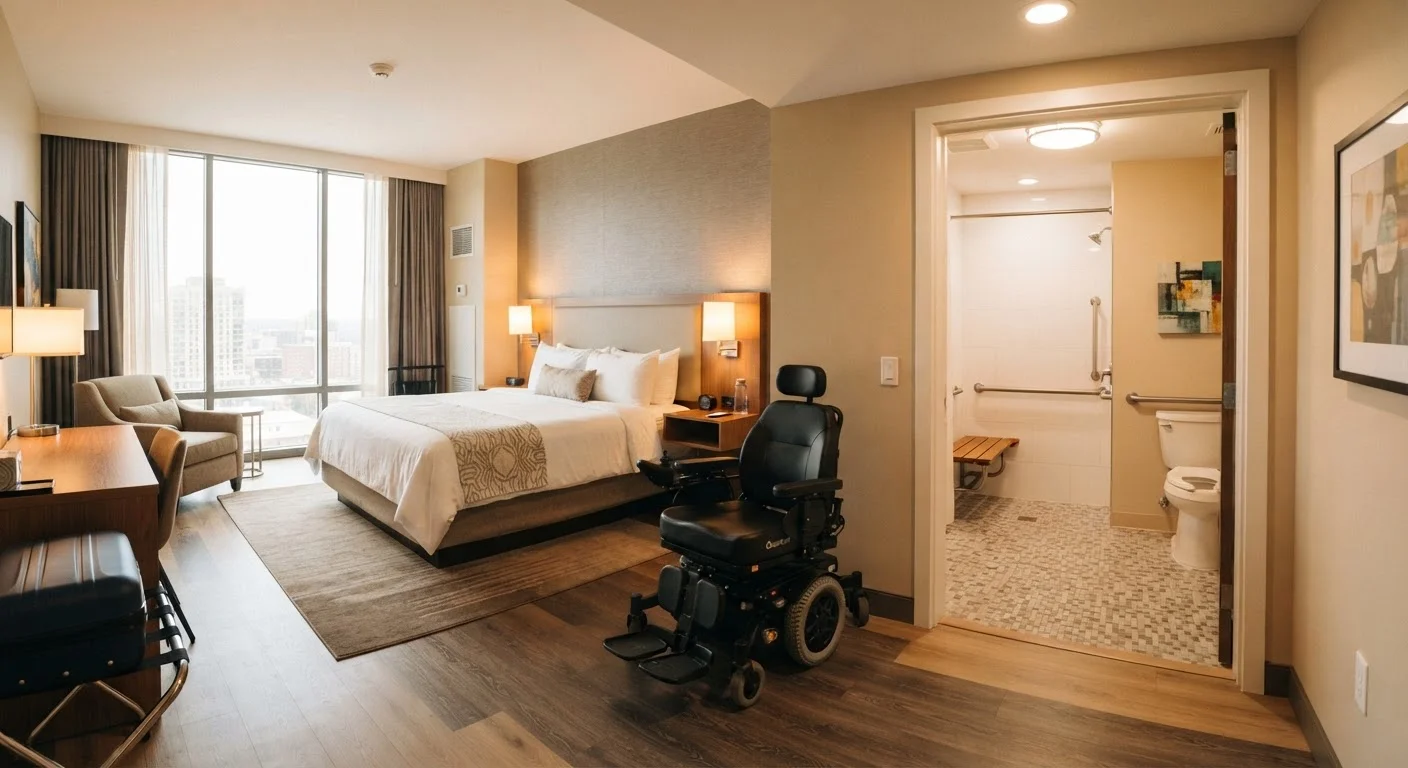
Key Takeaways
- "ADA accessible" is a minimum standard — always verify specific dimensions with the hotel directly.
- Power wheelchair and scooter users need to ask about turning radius clearance and charging outlets near the bed.
- Bathroom configuration (roll-in shower vs. tub) is the single most commonly mismatched feature for mobility aid users.
- Request your accessible room assignment in writing and reconfirm 48 hours before arrival.
- Property-wide accessibility — elevators, restaurant entrances, pool access — matters as much as the room itself.
Why Standard Accessibility Labels Are Not Enough
When a hotel lists a room as "ADA accessible," it signals that the property meets the minimum requirements set by the Americans with Disabilities Act. That baseline covers basics such as doorway widths, at least one accessible route, and bathroom grab bars. What it does not guarantee is that the room will work for your specific mobility aid — a rollator, a power wheelchair, or a travel scooter each has its own spatial footprint and its own set of requirements.
Hotels are also not required to have more than a small percentage of their rooms meet ADA standards, so accessible rooms can sell out quickly. Beyond legal minimums, the quality and layout of accessible rooms varies enormously even within the same hotel brand. One property may offer a spacious roll-in shower with a fold-down bench; another may technically comply while still having a narrow bathroom turn radius that a power chair cannot manage.
The starting point for any traveler using a mobility aid is to treat the accessibility label as a conversation opener — not a finished answer. For a broader overview of what preparation looks like before any reservation is confirmed, see our guide on planning around mobility needs.
Book Accessible Rooms Early — Availability Is Limited
Most hotels designate only a small number of rooms as ADA accessible, and those rooms are in high demand. Waiting until the last minute significantly increases the likelihood that accessible rooms will be fully booked. Contact the hotel directly as early as possible, confirm the specific room features you need, and get the assignment noted on your reservation in writing.
Room Layout and Space Requirements by Aid Type
Different aids demand different amounts of floor space, and understanding your equipment's dimensions is essential before selecting a room.
- Walkers and rollators require relatively modest clearance — generally 32 inches of door opening width is workable, though 36 inches is more comfortable. The key concern is clutter: bedside tables, luggage racks, and extra chairs can block the pathway between bed, bathroom, and exit. Ask whether furniture can be rearranged or removed on request.
- Manual wheelchairs need a minimum 60-inch turning diameter to maneuver comfortably within a room. A bed with open space underneath is useful for footrest clearance. Side transfer space beside the bed — at least 18 inches, ideally more — is critical for safe transfers.
- Power wheelchairs and mobility scooters are the most demanding in terms of floor space. A three-wheel scooter typically requires a turning radius of 50–60 inches; a power chair may need 67 inches or more. These devices cannot be folded to fit through a standard door, so the accessible room must have the wider 36-inch doorways — and ideally a 42-inch entry.
For travelers deciding between a rollator and a transport wheelchair, our comparison of rollators vs. transport wheelchairs breaks down the practical trade-offs.
36 in
Minimum ADA door clear width (accessible rooms)
The ADA Standards for Accessible Design require a minimum 32-inch clear opening at doorways, with 36 inches as the preferred standard for comfortable wheelchair passage.
60 in
Turning diameter needed for manual wheelchairs
ADA guidelines specify a 60-inch turning circle as the standard for wheelchair maneuverability in accessible spaces.
Bathroom Features That Matter Most
The bathroom is where accessibility mismatches most often occur. Hotels frequently have two types of accessible bathrooms: those with a roll-in shower (zero threshold entry) and those with a tub fitted with grab bars. If you cannot step over a tub ledge, only a roll-in shower is functional — and many properties have limited availability of that configuration.
When you call to confirm, ask specifically:
- Is the shower entry completely flush with the floor, or is there a small lip?
- Is there a fold-down or removable shower bench, and what is its weight rating?
- Where are the grab bars positioned — are they beside the toilet and inside the shower?
- What is the clear floor space alongside the toilet for a side transfer?
Our companion article on accessibility features that actually matter in a hotel room provides a detailed breakdown of which bathroom elements make the most practical difference.
Ask for Photos of the Accessible Bathroom
Most hotel staff can take and email a quick photo of the shower entry and grab bar placement on request. A visual confirmation takes seconds and removes any ambiguity about whether the space will work for your needs. This is especially important when booking roll-in shower availability, which is often limited to only one or two rooms per property.
Storing and Charging Your Mobility Aid
Room square footage shrinks considerably once a mobility device is parked inside. Before arrival, think through where the device will be positioned overnight and whether the room can accommodate it without blocking the path to the bathroom — a critical safety consideration for nighttime use.
For scooters and power wheelchairs, battery charging is a non-negotiable need. Ask the hotel where standard electrical outlets are located in the room — specifically whether there is an outlet near the bed or within reach of where the device will be parked. Extension cords can be a tripping hazard, so knowing the outlet placement in advance allows you to plan cord management carefully.
For manual devices such as folding walkers or collapsible wheelchairs, closet depth matters. A standard hotel closet may not accommodate a rollator standing upright; knowing this in advance lets you plan to keep it beside the bed rather than stored away.
If you are traveling by air with your mobility aid, our guide on mobility aids on planes covers how airlines handle these devices and what documentation may be required.
What to Confirm Before You Book
Calling the hotel directly — rather than relying solely on the booking platform's accessibility filters — is the most reliable way to verify what you actually need. Online listings are often incomplete or outdated. When you call, ask to speak with the front desk or accessibility coordinator and work through these points:
- The exact door width of the accessible room, including the bathroom door
- Whether the room has a roll-in shower or a tub
- The turning radius available inside the bathroom
- Outlet location relative to where a scooter or power chair would be parked
- Whether beds are adjustable-height or fixed, and the approximate height from floor to mattress top
- Whether accessible rooms are bookable directly or require a phone request
Once confirmed, ask for the details in writing — either via email confirmation or a note added to your reservation. Reconfirm the specific room assignment 48 hours before arrival so there are no last-minute substitutions. Our room-by-room accessibility checklist provides a printable reference you can use during this call.
When calling a hotel, ask a specific, testable question: 'Can you measure the clear floor space between the toilet and the near wall?' Vague answers — 'Oh yes, it's spacious' — are a signal to probe further or choose a different property.
Generic assurances from reservation staff often reflect a lack of firsthand knowledge about the room. Specific measurable questions force staff to either look up accurate details or escalate to someone who can.
Request a ground-floor accessible room as a backup option, even if you plan to use the elevator. If the elevator is out of service, a ground-floor assignment means you are never stranded.
Elevator outages at hotels are not uncommon, and for travelers who cannot use stairs, a ground-floor backup room can prevent a serious disruption to travel plans.
Navigating the Property Beyond Your Room
A well-configured accessible room loses much of its value if the rest of the property presents obstacles. When researching a hotel, consider the full route you will travel from arrival to your room and through common areas:
- Entrance and parking: Is there a ramped or level entrance close to the accessible parking spaces? Does the front door require pulling — difficult with a walker — or is there an automatic opener?
- Elevators: Confirm that the hotel has at least one elevator large enough to accommodate a scooter or power chair. Ask for the interior dimensions. Older boutique hotels sometimes have elevators too small for power devices.
- Dining and amenities: Check whether the restaurant, pool, and fitness areas have step-free access. Many hotels have main dining rooms that are fully accessible while breakfast areas or bars require navigating a step or two.
- Housekeeping paths: Request that housekeeping staff be informed not to move or rearrange your mobility equipment.
If your trip involves getting around the destination city after you check in, our guide on getting around a new city with limited walking ability covers accessible transport options and practical strategies. For general guidance on building an accessible trip from the ground up, the first-timer's guide to planning an accessible trip is a useful starting point.
Accessible Room Policies Vary by Property
Some hotels reserve accessible rooms exclusively for guests who request them for disability-related needs; others release them to any guest when availability is low. If an accessible room is essential for your safety, communicate that clearly when booking and again at check-in. While hotels generally try to honor these requests, there is no federal requirement that guarantees an accessible room will be available for every guest who needs one, so booking as early as possible is advisable.