

| Advance notice recommended | At least 48 hours before departure (U.S. Department of Transportation guidance) |
| Folding walker cabin storage | Overhead bin or coat closet (aircraft-dependent) |
| Rollator typical handling | Gate-checked; retrieved planeside |
| Power wheelchair transport | Always checked as cargo; never in cabin (U.S. DOT Air Carrier Access Act rules) |
| Battery types requiring documentation | Sealed lead-acid and lithium-ion (IATA / PHMSA regulations) |
| Damage claim best practice | Report at airport before leaving terminal |
What Counts as a Mobility Aid — and Why It Matters at the Airport
Airlines treat mobility aids differently from standard checked luggage, and understanding that distinction is the first step to a smoother trip. Under U.S. Department of Transportation rules, carriers are required to accommodate passengers traveling with wheelchairs, scooters, walkers, and other assistive devices — but the specifics depend heavily on which type of device you bring.
| Advance notice recommended | At least 48 hours before departure (U.S. Department of Transportation guidance) |
| Folding walker cabin storage | Overhead bin or coat closet (aircraft-dependent) |
| Rollator typical handling | Gate-checked; retrieved planeside |
| Power wheelchair transport | Always checked as cargo; never in cabin (U.S. DOT Air Carrier Access Act rules) |
| Battery types requiring documentation | Sealed lead-acid and lithium-ion (IATA / PHMSA regulations) |
| Damage claim best practice | Report at airport before leaving terminal |
Broadly, mobility aids fall into three categories relevant to air travel: folding walkers, rollators (wheeled walkers with hand brakes), and power wheelchairs or scooters. Each has a different size profile, battery type (if any), and handling procedure. See our comparison of rollators and transport wheelchairs for help choosing the right device before you book.
If you use any of these devices, notify your airline at least 48 hours before departure — many carriers have specific forms or service desks dedicated to this. Early notice gives the airline time to prepare appropriate storage, allocate aisle chair assistance, and brief ground staff.
Folding Walkers and Rollators: Cabin vs. Hold
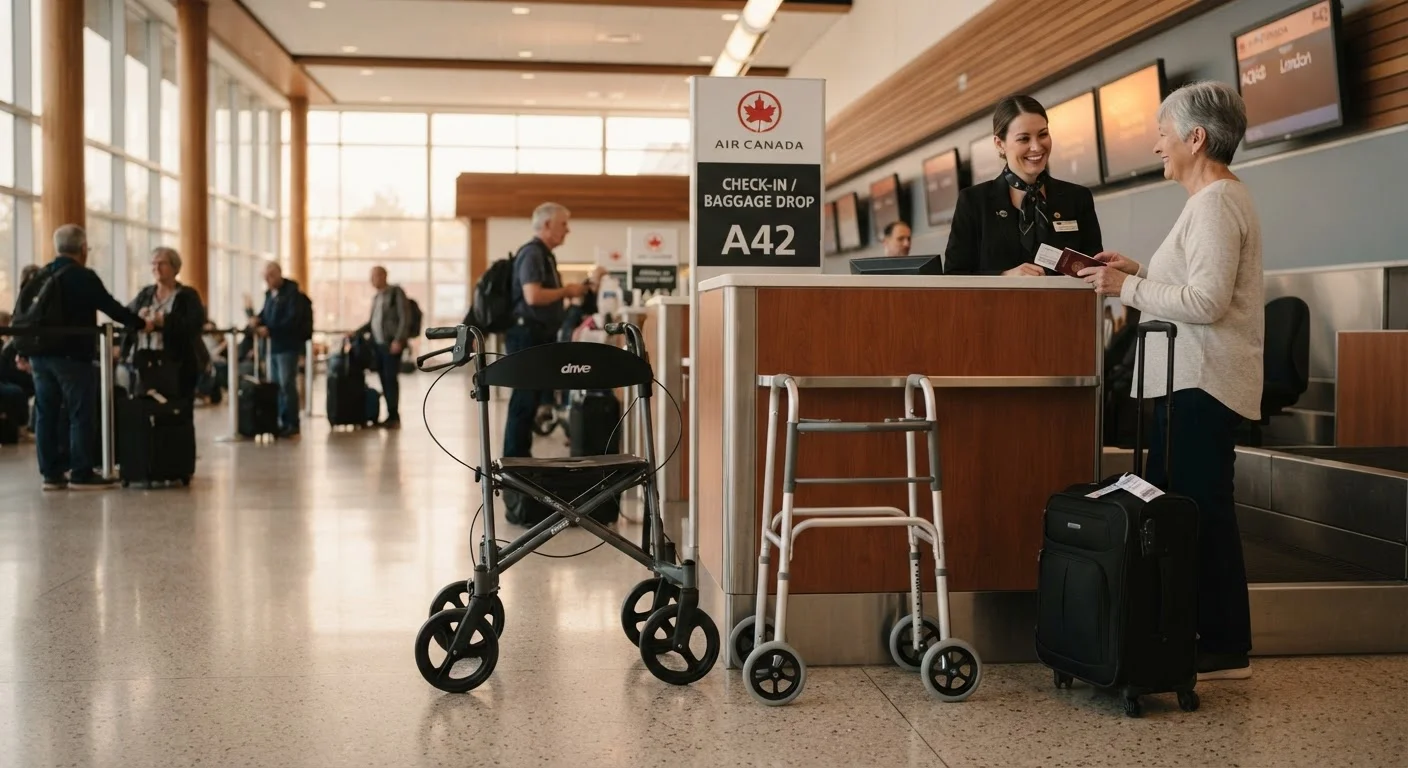
Compact, non-motorized mobility aids such as folding walkers and standard rollators are among the more straightforward devices to bring on a plane — but storage options vary by aircraft.
Folding Walker
A non-wheeled walking aid with a collapsible frame that folds flat for storage. It is typically lightweight and may fit in an aircraft overhead bin depending on the plane size.
Rollator
A wheeled walker with handbrakes and, often, a built-in seat. Rollators are larger than standard walkers and are usually gate-checked rather than brought into the cabin.
Gate-Checking
A process in which passengers hand over a device at the aircraft door rather than at the main check-in desk. The item is stored in the cargo hold and returned planeside at the destination.
Aisle Wheelchair
A narrow, onboard wheelchair used by airline staff to help passengers with mobility limitations move through the aircraft cabin, from their seat to the door and vice versa.
Sealed Lead-Acid (SLA) Battery
A rechargeable battery type commonly found in power wheelchairs. Airlines have specific requirements for how SLA batteries must be disconnected and secured before the device is placed in cargo.
Lithium-Ion Battery
A lighter, high-energy battery used in some modern mobility devices. Lithium-ion batteries are subject to strict airline and regulatory rules due to fire risk, and require advance approval from the carrier.
Folding walkers collapse flat and are typically lightweight enough to fit in an overhead bin or a coat closet at the front of the cabin, if one is available. Flight attendants are generally required to make reasonable efforts to store these devices in the cabin. However, on smaller regional aircraft with limited overhead space, the walker may need to be gate-checked and stored in the cargo hold.
Rollators — which include a frame, wheels, handbrakes, and often a seat — are larger and less likely to fit in overhead bins. Most rollators are gate-checked, meaning you use the device up to the aircraft door and retrieve it planeside at your destination. Ask your airline in advance whether planeside retrieval is guaranteed, as policies differ.
For more guidance on managing mobility through big terminals, see navigating large airports when mobility is a challenge.
Power Wheelchairs and Scooters: Battery Rules and Handling
Power wheelchairs and mobility scooters introduce an additional layer of planning because they are battery-operated. Airlines follow guidelines set by the Pipeline and Hazardous Materials Safety Administration (PHMSA) and the International Air Transport Association (IATA) for battery transport.
Battery Documentation Is Essential
Before flying with a power wheelchair or scooter, locate your device's battery specification sheet — it should list battery type, watt-hour rating, and whether it is spillable or non-spillable. Airlines may request this information when you check in, and some require it submitted in advance. Keep both a printed and digital copy accessible throughout your journey.
Most power chairs use one of two battery types: sealed lead-acid (SLA) or lithium-ion. Each has different airline requirements for how the battery must be disconnected, protected, or labeled. Check your device's documentation and share it with the airline before your flight.
Power chairs are always checked as cargo — they do not travel in the cabin. Airlines are required by U.S. DOT rules to load, stow, and return these devices without causing damage, and to provide written receipts when you check them in. Photograph your device thoroughly before handing it over, and note any existing scuffs or damage in writing.
If your chair is damaged in transit, the airline is responsible under federal law. Filing a report before leaving the airport is essential — damage claims are significantly harder to resolve after you've left the terminal. For broader context on traveling with powered medical equipment, see flying with a medical device.
Before You Fly: A Practical Preparation Checklist
Preparation reduces the chance of delays, miscommunication, or damaged equipment. Consider these steps well in advance of your departure date.
- Contact the airline directly — notify them of your mobility aid type, dimensions, weight, and battery specifications (if applicable) at booking and again 24–48 hours before travel.
- Request an aisle wheelchair — these narrow chairs allow crew to assist you from your seat to the aircraft door and are available on request at most commercial airports.
- Measure and document your device — note folded dimensions, total weight, and battery model number. Keep a printed copy with your travel documents.
- Arrive early — extra time reduces stress and allows airline staff to coordinate gate-checking or cargo loading without rushing.
- Plan for your destination — confirm that your hotel and planned activities can accommodate your device. Our article on hotel stays with mobility aids covers what to verify before you arrive.
For a deeper look at communicating accessibility needs before booking, see planning around mobility needs.
This article provides general travel information and is not a substitute for guidance from your airline, healthcare provider, or a qualified accessibility specialist. Policies change; always verify current rules directly with your carrier before traveling.