

Key Takeaways
- Rollators support independent walking; transport wheelchairs require a companion or attendant to push.
- Transport wheelchairs typically fold smaller and weigh less than rollators, easing luggage and storage concerns.
- Airport staff can assist with either device, but declaring your aid in advance smooths the process significantly.
- Terrain matters: rollators handle smooth surfaces well, while transport wheelchairs depend on the pusher to manage slopes.
- Your current stamina and the physical demands of your itinerary should drive the final choice — not convenience alone.
- Always consult your healthcare provider before changing or selecting a primary mobility aid for travel.
Option A
Rollator
The independent, self-propelled walking aid.
Best for: Seniors who can walk but need stability support, a rest seat, and storage while moving through destinations on their own.
Option B
Transport Wheelchair
The compact, companion-assisted mobility solution.
Best for: Travelers who tire quickly or cannot safely self-propel over longer distances, and who will have a companion or porter available to assist.
If you walk independently but fatigue over long distances
Rollator
A rollator lets you pace yourself, sit when needed, and move without relying on a companion — ideal for museum corridors, boardwalks, or cruise decks.
If you are traveling with a partner or caregiver who can push
Transport Wheelchair
A transport wheelchair is lighter, folds more compactly, and covers ground faster when someone else is steering — reducing fatigue for both of you.
If your trip involves cobblestones, gravel, or uneven terrain
Rollator
Larger rollator wheels manage textured surfaces more effectively than the small castors typical on transport wheelchairs.
If overhead bin space or trunk storage is limited
Transport Wheelchair
Most transport wheelchairs fold flat into a compact package, making them easier to stow in vehicle trunks, hotel closets, and ship cabins.
If you want maximum flexibility across airports, tours, and city streets
Rollator
The rollator's dual role as walking support and rest seat gives solo or lightly assisted travelers the widest range of movement options.
Understanding What Each Aid Actually Does
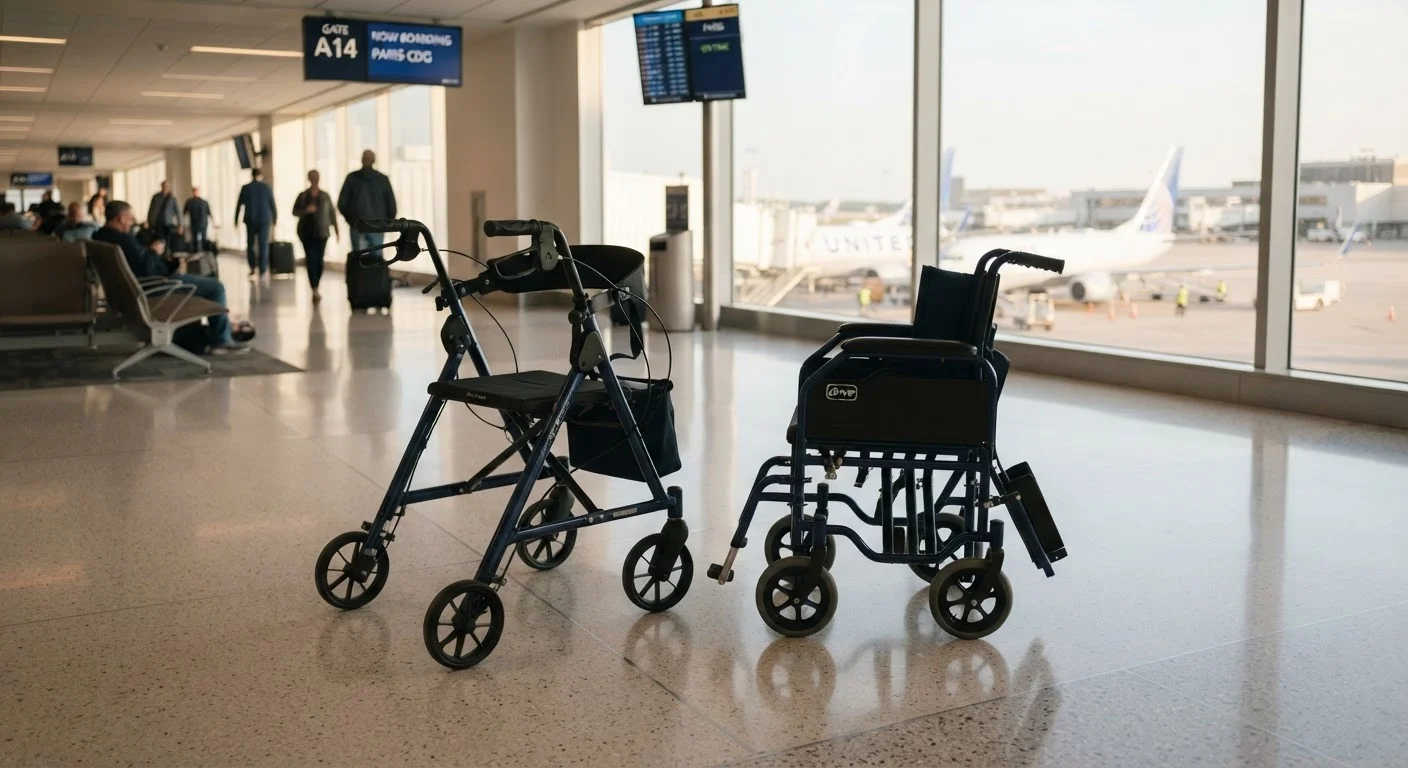
A rollator is a wheeled walking frame — typically with three or four wheels, hand brakes, and a built-in seat — that you push ahead of you as you walk. It supports your balance and lets you rest briefly without finding a chair. A transport wheelchair, sometimes called a companion wheelchair, is a lightweight chair with small rear wheels that someone else pushes. Unlike a standard manual wheelchair, it is not designed for self-propulsion; it is built for assisted travel over moderate distances.
Understanding this fundamental difference is the starting point for any decision. One device extends your walking independence; the other transfers the physical effort to a companion or airport porter. Neither is inherently better — they address different functional needs.
For a broader look at how airlines and cruise operators handle both types of device, see our guide on mobility aids on planes, which covers airline-specific rules and preparation steps.
Head-to-Head: Key Travel Criteria
When you weigh these two aids against the practical demands of travel, several factors emerge as especially important: weight, folded size, terrain adaptability, stamina requirements, and airport handling. The table below summarises the most relevant trade-offs.
| Criterion | Rollator | Transport Wheelchair |
|---|---|---|
| Self-propelled | Yes — user walks independently | No — companion or staff must push |
| Typical weight range | 15–20 lbs (lightweight models) | 15–25 lbs |
| Folded compactness | Moderate — folds but remains bulky | Very compact — folds flat |
| Built-in seat | Yes | Yes (the chair itself) |
| Terrain adaptability | Good — larger wheels handle uneven surfaces | Limited — small castors struggle on rough ground |
| Storage in vehicles | Trunk or bus bay (bulkier) | Trunk or bus bay (more compact) |
| Airport assistance compatibility | Gate-checked; user walks through terminal | Gate-checked; staff can push through terminal |
| Stamina required from user | Moderate — must walk with support | Minimal — fully seated transport |
Weight is a frequent deciding factor. Most transport wheelchairs weigh between 15 and 25 pounds, while rollators typically fall in the 15–20 pound range for lightweight models, though heavier-duty versions can exceed that. Always confirm the specifications of any device you plan to travel with.
Airports, Cruise Ports, and Tour Buses
In airports, both aids qualify for gate-check status, meaning you can use them up to the aircraft door and collect them on arrival at the jet bridge. However, rollators with seats can sometimes serve as a waiting chair at the gate, reducing dependence on scarce seating. Transport wheelchairs, by contrast, may allow airport staff to push you through security and to the gate more efficiently — particularly useful in large hubs where distances between terminals are significant.
At cruise ports, gangways vary in slope and width. Rollators generally manage moderate inclines independently; transport wheelchairs will depend on your companion's strength and the availability of port staff. Many cruise lines offer onboard wheelchair loan programs — worth confirming before you sail.
Tour buses present a particular challenge. Steps are steep, and most coaches do not have lifts. A compact, folded transport wheelchair can typically be stowed in the luggage bay; a rollator may be stored in the bus aisle or bay depending on the operator. Confirm storage arrangements directly with your tour company. Our article on getting around a new city when walking is difficult covers additional urban transit strategies worth reviewing.
Declare Your Aid When You Book
Airlines, cruise lines, and rail operators all have processes for accommodating mobility aids, but they work best when notified in advance — ideally at the time of booking. Provide the folded dimensions and weight of your device, and confirm whether it will be gate-checked or stored in the hold. Last-minute requests are harder to fulfill, and policies vary by carrier, so verifying directly with your provider is always the safest step.
Making the Decision: Matching the Aid to Your Itinerary
The right choice depends on an honest assessment of your current stamina, the physical layout of your destinations, and your travel party. Ask yourself: Can I walk short-to-moderate distances safely with support, or do I need to be seated for most transit? If the former, a rollator preserves your independence. If the latter, a transport wheelchair with a reliable companion may be far less tiring overall.
Consider your itinerary terrain. Historic European city centres, for example, often feature cobblestone streets that challenge small-wheeled transport chairs. National park visitor centres and resort boardwalks tend to be smooth and rollator-friendly. Beach destinations and garden tours may require a powered alternative altogether.
If your trip involves a hotel stay, planning your hotel room layout in advance can prevent surprises — corridor widths, bathroom grab bars, and elevator access all vary significantly. And if you are still in the early planning stages, our guide to planning around mobility needs before you book walks through how to communicate your requirements with airlines, hotels, and tour operators.
This article provides general informational content about mobility aid options for travel. It is not medical advice. Please consult your doctor, physiotherapist, or occupational therapist before selecting or switching mobility aids, particularly if your needs have changed recently.