

Key Takeaways
- Request wheelchair or mobility assistance directly from your airline at least 48 hours before departure.
- Arrive earlier than standard recommendations — allow at least 30 extra minutes for large airports.
- Moving walkways, airport shuttles, and trams can significantly reduce walking distances between gates.
- Review the airport's accessibility map in advance to identify rest areas, elevators, and assistance desks.
- Traveling with a mobility aid requires notifying your airline ahead of time about the specific device.
- Federal law (the Air Carrier Access Act) requires U.S. airlines to provide assistance at no extra charge.
What you will need
Why Large Airports Require Extra Planning
Major U.S. airports — such as those in Atlanta, Chicago, Dallas, and Los Angeles — can span several miles of terminal space. For travelers managing joint pain, limited stamina, or a mobility aid, even a single connection can involve distances that feel overwhelming without preparation.
The good news is that a robust framework of accessibility services exists at virtually every commercial airport in the United States. Under the Air Carrier Access Act (ACAA), airlines are legally required to provide mobility assistance at no cost to passengers who request it. Understanding how to access these services — and planning around the physical layout of your specific airport — is the key to a smoother journey.
For a broader look at accessibility options from the moment you arrive at the curb, see our guide to airport accessibility from kerb to gate.
What you will need
Step-by-Step: Getting Through the Airport with Ease
Follow these steps to navigate a large airport confidently, whether you use a mobility aid or simply need more time and support than the average traveler.
Contact Your Airline to Request Mobility Assistance
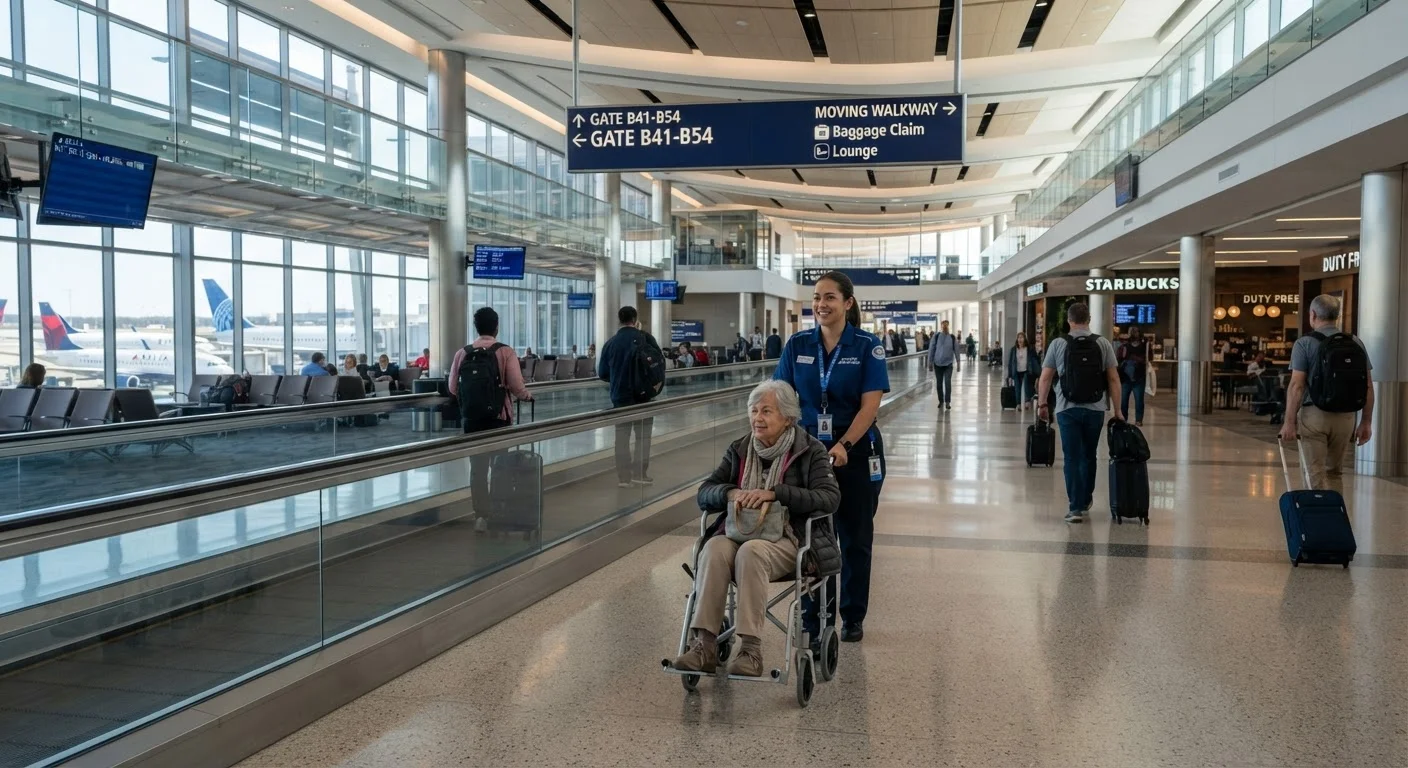
Call or use the airline's website to request wheelchair or escort assistance as soon as your booking is confirmed — ideally at least 48 hours before departure. Specify whether you need a wheelchair, can walk short distances, or require assistance only for longer distances. This request is logged on your reservation and passed to airport staff.
Arrive Earlier Than the Standard Recommendation
Most airports suggest arriving 2 hours before domestic flights and 3 hours before international ones. If you use a mobility aid or anticipate needing extra time at security or the gate, add at least 30 additional minutes. Rushed travel in large airports is one of the most common causes of stress and fall risk for senior travelers.
Identify Your Drop-Off Point and Check-In Location
Large airports often have multiple terminals served by different airlines. Before you travel, confirm which terminal your airline uses and where the accessible drop-off zone is located. If you're using a ride-share or taxi, tell the driver you need the accessible drop-off area so they can position appropriately.
Use TSA Security Assistance Designed for Mobility Needs
Inform the TSA officer at the checkpoint that you have a mobility limitation. Officers are trained to accommodate travelers who cannot stand in the body scanner, remove shoes, or lift bags onto the belt without help. You may request a private screening room if needed. Mobility aids — including wheelchairs, walkers, and scooters — go through screening but are never taken away from you without your consent.
Navigate the Concourse Using Available Airport Transit
After clearing security, look for moving walkways, trams, or inter-terminal shuttles before walking the full length of a concourse. If your wheelchair assistance has been arranged, your escort will already know the most accessible route to your gate. If you're traveling independently, check the airport's terminal map for elevator locations — these are essential if your gate requires a level change.
Notify Gate Staff Upon Arrival at Your Gate
Introduce yourself to the gate agent and let them know you will need pre-boarding assistance. Airlines are permitted to board passengers requiring extra time before general boarding begins. This allows you to settle into your seat, stow your carry-on at your own pace, and get settled without the pressure of a crowded aisle behind you.
Plan Your Airport Route Before You Leave Home
Most large airports publish detailed accessibility maps on their official websites, including elevator locations, accessible restroom positions, and distances between concourses. Reviewing this map before departure day — and identifying your gate area if it's been assigned — lets you mentally rehearse the journey and ask the right questions when you arrive. This small step can meaningfully reduce stress on travel day.
Inside the Terminal: What to Expect
Once you clear security, most large airports offer several features designed to reduce physical strain. Moving walkways are common in long concourses — step onto them even if you're walking, as they cut distance meaningfully. Automated people movers (tram systems) connect terminals at airports like Denver International and Detroit Metropolitan, eliminating long walks between concourses entirely.
Look for airport accessibility desks or information kiosks staffed by airport employees — not airline staff — who can direct you to the nearest elevator, accessible restroom, or quiet seating area. Most major airports also publish detailed terminal maps on their websites that indicate elevator locations, accessible routes, and family or companion restrooms.
If you're traveling with a walker, rollator, or power wheelchair, rules about how airlines handle these devices vary by aircraft and carrier. Our article on mobility aids on planes explains what to expect and how to prepare. And if you're continuing your journey beyond the airport, getting around a new city with limited mobility offers practical strategies for your destination.
Escalators Are Not Always a Safe Alternative
In busy terminals, it can be tempting to use an escalator when an elevator involves a detour. However, escalators carry real fall risk for travelers with balance issues, joint instability, or rollators. Always locate and use the elevator, even if it adds a few minutes to your walk. If you're unsure where the nearest elevator is, ask any airport staff member — they are trained to direct you.