

Key Takeaways
- U.S. federal law requires airlines and airports to provide accessibility assistance at no extra charge.
- Requesting wheelchair or mobility assistance in advance significantly reduces stress on the day of travel.
- Accessible drop-off zones, dedicated security lanes, and boarding lifts are standard at most major airports.
- Arriving earlier than usual gives you comfortable time to use services without rushing.
- Always confirm your accessibility requests directly with your airline at least 48 hours before departure.
Understanding Your Rights as a Passenger
For travelers in the United States, the Air Carrier Access Act (ACAA) is the foundational law protecting the rights of people with disabilities when flying. Under this federal regulation, airlines are prohibited from discriminating against passengers on the basis of disability and are required to provide a range of accessibility services — at no additional cost to the traveler.
This applies whether you use a wheelchair, have difficulty walking long distances, experience cognitive challenges, or live with a condition that isn't immediately visible. You don't need a formal diagnosis or documentation to request assistance; simply communicating your needs is enough to trigger a legal obligation on the airline's part.
To learn what the term "accessible travel" actually covers in practice, see our overview of what accessible travel really means before you book.
Your Rights Cannot Be Waived or Charged For
Under the Air Carrier Access Act, airlines cannot require advance notice as a condition of providing most accessibility services, nor can they charge extra fees for wheelchair assistance, aisle chair transfers, or storing your mobility device. If you believe your rights have been violated, you can file a complaint with the U.S. Department of Transportation. Knowing this in advance can make it easier to advocate for yourself calmly and confidently.
Accessible Drop-Off and Kerb-Side Arrival
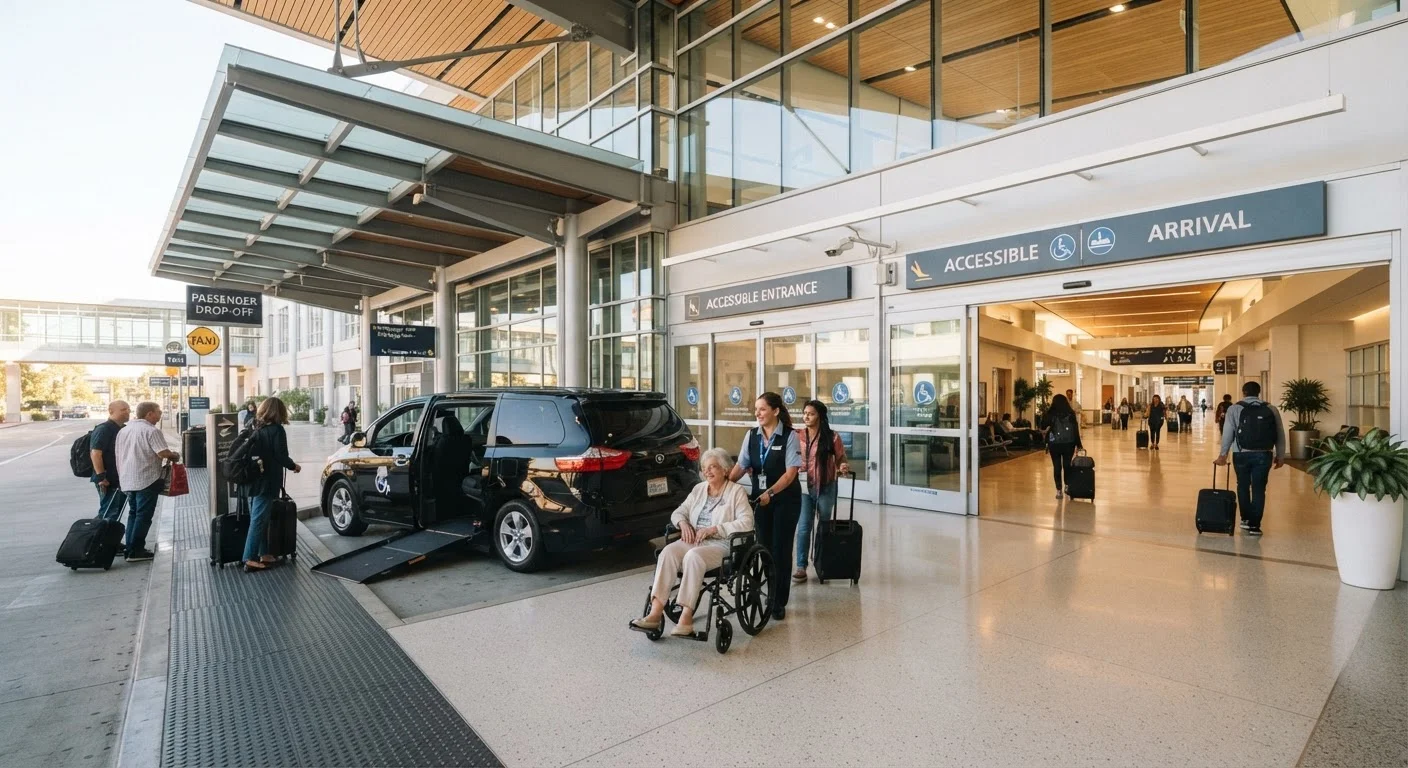
The airport journey starts at the kerb, and most major U.S. airports designate clearly marked accessible drop-off zones close to terminal entrances. These areas are reserved for passengers who need closer access and are typically monitored by airport staff or ground transportation coordinators.
If you're arriving by taxi, rideshare, or private vehicle, it's worth asking the driver in advance to confirm they can use the accessible lane. Many airports also have dedicated accessible parking structures with wider bays, elevator access to terminals, and shuttle services for those who cannot walk long distances from the lot.
Ask for a Luggage Porter at the Entrance
Many travelers don't realize that skycap or porter services at the kerb can check your bags directly, saving you the trip to the main check-in counter. This is especially helpful if you're managing a rollator, cane, or other mobility aid alongside your luggage. A small gratuity is customary but the service itself is often complimentary through the airline.
Once inside, look for the information or assistance desk, usually located near the main entrance. Staff there can connect you with a porter service for your luggage and direct you to the nearest mobility aid station.
Requesting Wheelchair and Mobility Assistance
Wheelchair assistance is one of the most widely used accessibility services at airports — and it's available to anyone who needs it, not only those who use a wheelchair full-time. If walking extended distances is uncomfortable or tiring, you are entirely within your rights to request a chair and an escort to guide you through check-in, security, and all the way to your gate.
When requesting wheelchair assistance, specify whether you need help all the way to your seat on the aircraft — not just to the gate. Some airlines treat gate-to-seat escort as a separate request.
Passengers are sometimes left at the gate without an aisle chair escort, which can lead to a difficult boarding experience. Clarifying this in advance prevents gaps in service.
If you use a power wheelchair or scooter, photograph it from multiple angles before handing it over at check-in. Note any pre-existing marks and ask the agent to record them.
Documenting the condition of your mobility device before it's stored in the hold protects you in the event of any handling damage and supports any claim you may need to make.
To request this service, contact your airline directly when booking or at least 48 hours before your flight. On the day of travel, check in at the airline counter or curbside and remind staff of your request. An airline representative or contracted airport assistant will then accompany you throughout the terminal.
For a deeper look at communicating mobility needs before you ever arrive at the airport, our guide on planning around mobility needs before you book walks through exactly what to ask and when.
~4 million
Passengers requesting disability assistance annually at U.S. airports
Figures compiled by the U.S. Bureau of Transportation Statistics indicate millions of passengers use airline accessibility services each year, reflecting how common and well-established these services are.
48 hrs
Recommended advance notice for mobility assistance
Most major U.S. airlines and airport accessibility guidelines recommend notifying the carrier at least 48 hours before departure to ensure services are confirmed.
Navigating Security and Terminal Facilities
TSA (Transportation Security Administration) checkpoints can feel daunting, but accessible options are in place. Passengers who cannot stand in a standard screening lane or remove shoes and belts easily can request a modified screening procedure. This may include a pat-down in lieu of walking through a scanner, or seated screening if standing for a period is not possible.
You can notify a TSA officer of your needs upon arrival at the checkpoint. A TSA Notification Card — available for download from the TSA website — allows you to discreetly communicate your needs in writing, which many travelers find more comfortable than explaining verbally in a busy queue.
Inside the terminal, look for: accessible restrooms with grab rails, quiet or low-stimulation seating areas, charging stations near gate seating, and family or companion restrooms where a caregiver can assist. Most major airports now display accessibility amenity maps on their websites and apps.
TSA Cares: A Pre-Travel Helpline
The TSA operates a dedicated helpline called TSA Cares, which passengers with disabilities or medical conditions can call ahead of travel to ask questions and arrange a passenger support specialist to assist them through the security checkpoint. This free service can meaningfully reduce anxiety about the screening process. Contact details are available on the official TSA website.
Boarding Assistance and Aircraft Access
Boarding is one of the areas where accessibility services make the most tangible difference. Passengers who have requested assistance are typically offered priority boarding, allowing extra time to settle in without the pressure of a crowded aisle. Gate agents can arrange this; simply confirm your request when you arrive at the gate.
For passengers who cannot climb jet bridge stairs, airports and airlines use aisle wheelchairs — narrow chairs designed to fit aircraft aisles — and where jet bridges aren't available, boarding lifts are used to bring passengers directly to the aircraft door. Federal rules require airlines operating aircraft with 30 or more seats to provide this equipment.
If your own mobility device — a manual or powered wheelchair, scooter, or walker — is being checked, the airline must tag it as priority baggage and return it to you at the aircraft door or, at minimum, at baggage claim. Confirm this preference clearly at check-in.
For tips on managing the full terminal experience at large, complex airports, see our companion piece on navigating large airports when mobility is a challenge.
Planning Ahead for a Smoother Experience
The single most effective step any senior traveler can take is to build in extra time. Arriving at the airport 30 to 60 minutes earlier than you normally would — on top of standard check-in recommendations — means that using accessibility services feels relaxed rather than rushed. There's no penalty for arriving early, and the comfort it provides is substantial.
Before you travel, visit your departing airport's official website to locate its accessibility or special assistance page. Many publish terminal maps highlighting accessible routes, elevator locations, and family restroom positions. Download their app if one is available — several major airports include real-time navigation tools.
If this is your first time traveling with accessibility needs, our introductory guide on planning an accessible trip as a first-timer offers a calm, step-by-step orientation to the whole process. And for broader booking considerations, the Booking Made Easy hub covers how to integrate accessibility requests into your reservations from the very start.
This article is for general informational purposes only. Specific accessibility services, facilities, and policies vary by airport and airline. Always verify current services directly with your carrier and airport before you travel.