
Accessible Room Requests: Getting the Right Accommodation Before You Arrive

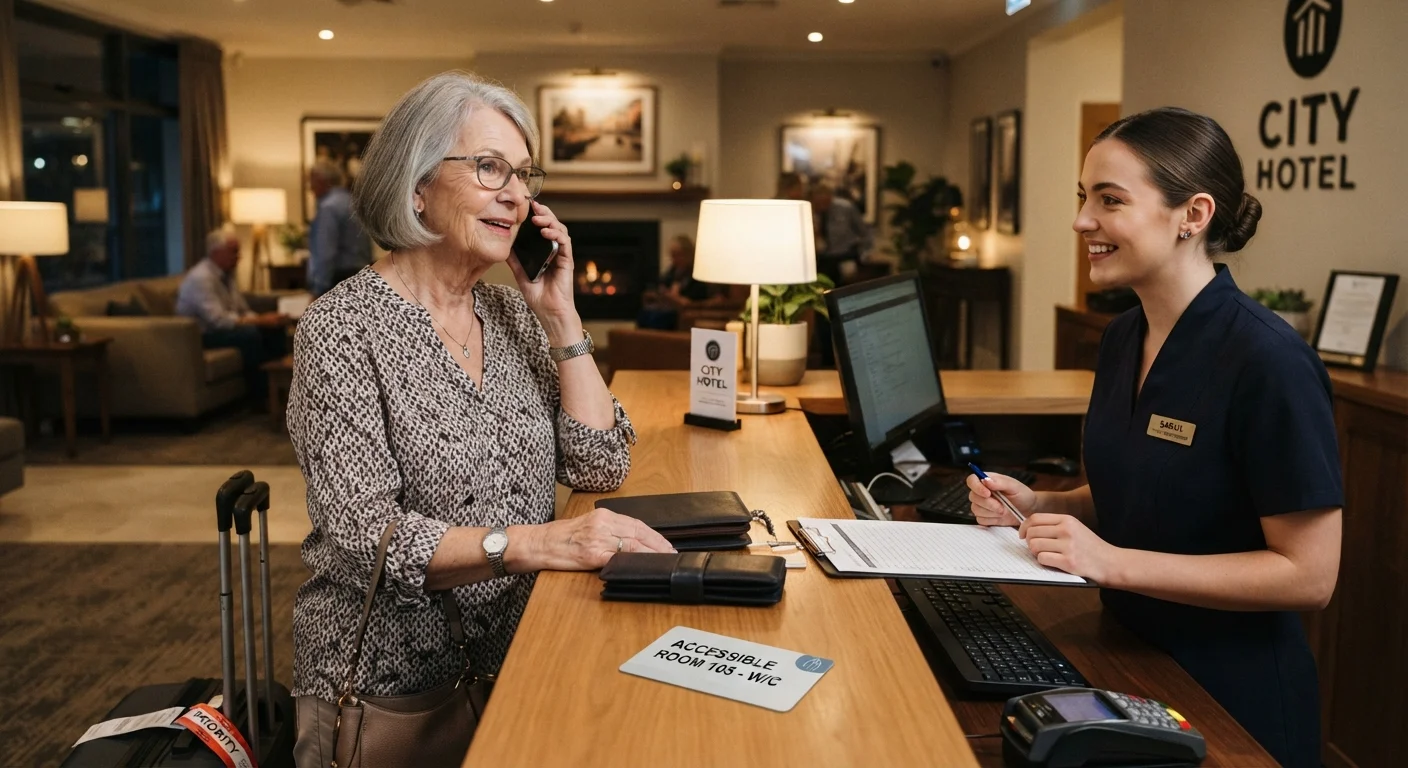
Key Takeaways
- Accessible room requests must be made proactively — hotels rarely assign them automatically.
- Calling the hotel directly after booking online is the most reliable way to confirm specific needs.
- Written confirmation of your request creates a record that protects you if something goes wrong.
- Accessibility labels vary widely between properties — always ask for specific feature details.
- Following up 48 hours before arrival significantly reduces the chance of an unpleasant surprise.
Why Accessible Rooms Rarely Assign Themselves
Many travelers assume that selecting "accessible room" during an online booking automatically guarantees the features they need. In practice, that's rarely how it works. The term "accessible" is not standardized across hotels — one property's accessible room may include a roll-in shower and grab bars throughout, while another's may simply have a slightly wider door. As our related guide explains, hotel accessibility labels are inconsistent worldwide, making it essential to verify specifics before you arrive.
Online booking systems are also limited. They capture room category preferences, not nuanced individual needs. A note typed into a "special requests" field during checkout is not a confirmed arrangement — it's a message that may or may not be read before your check-in date. Taking a few extra steps to communicate directly makes a significant difference.
Online Booking Fields Are Not Confirmed Requests
Most hotel booking platforms include a "special requests" text box during checkout. While it's worth using this field, entries are not binding commitments from the hotel. They are informal notes that may or may not be acted upon. Always follow up directly with the property to turn a request into a confirmed arrangement.
Best Practices for Requesting Accessible Accommodations
The following practices give you the strongest chance of arriving to a room that genuinely meets your needs. Each one is straightforward to implement, even if you're not comfortable with technology.
Book the accessible room category online, then call the hotel directly to confirm your specific needs.
Online systems capture category preferences but cannot communicate nuanced requirements. A direct phone call puts you in contact with someone who can verify what the accessible room actually includes and note your individual needs on the reservation.
Request written confirmation of every accessibility arrangement you've discussed.
Verbal agreements are easily lost in a busy front desk environment. A written record — even a brief email — gives you something concrete to reference if the room assigned at check-in doesn't match what was promised.
Be specific about features, not just labels — describe your actual functional needs.
Accessibility categories differ significantly between properties. Describing what you physically need (rather than asking for an "ADA room") helps staff match you to the room that genuinely fits, even if their internal labeling differs.
Follow up with the hotel 48 hours before arrival to reconfirm your room assignment.
Room assignments can change due to maintenance issues, overbooking, or staff turnover between your booking date and check-in. A brief call shortly before arrival catches problems while there is still time to resolve them.
Arrive with your written confirmation and be prepared to advocate calmly at check-in.
Even well-organized hotels occasionally make errors. Having your documentation on hand — and knowing what was agreed — allows you to address discrepancies politely but firmly before you are settled into the wrong room.
What to Say When You Call
Many seniors feel uncertain about what to ask for. You don't need to know the technical terminology — describe what you need in plain terms. For example: "I use a walker, so I need enough turning space in the bathroom" or "I have difficulty with stairs, so I need to be on the ground floor or near an elevator."
If you'd like a structured list of questions to bring to that conversation, our curated accessibility question guide can help you prepare. And for a room-by-room breakdown of what to evaluate — from bed height to bathroom grab bars — see our room-by-room accessibility checklist.
Confirming, Following Up, and Arriving Prepared
Once your request is made, ask the hotel to send written confirmation — even a brief email summary is enough. Save it alongside your booking reference. Then, call back 48 hours before arrival to confirm the room assignment hasn't changed. Front desk staff handle many reservations; a brief reminder keeps yours visible.
If you're traveling with mobility equipment or have needs that extend beyond the hotel room — such as airport assistance or adapted transport — special assistance at airports and stations follows its own separate process and should be arranged in parallel. For broader guidance on coordinating mobility needs across your whole trip, see planning around mobility needs before you book.
~1 in 4
U.S. adults living with a disability
According to the U.S. Centers for Disease Control and Prevention (CDC), approximately 1 in 4 American adults has some form of disability, with prevalence increasing significantly among adults over 65.
65+
Age group most affected by mobility limitations
The CDC reports that mobility limitations are among the most common disability types in the U.S., and are disproportionately experienced by adults aged 65 and older.
Arriving with documentation, a confirmed room number, and a calm plan puts you in a much stronger position if anything needs to be corrected at check-in. It also relieves a great deal of pre-trip anxiety — which is reason enough to follow through.
For further advice on how to communicate your needs confidently with hotel staff from booking through check-in, see requesting special accommodations: a practical approach that actually works.