

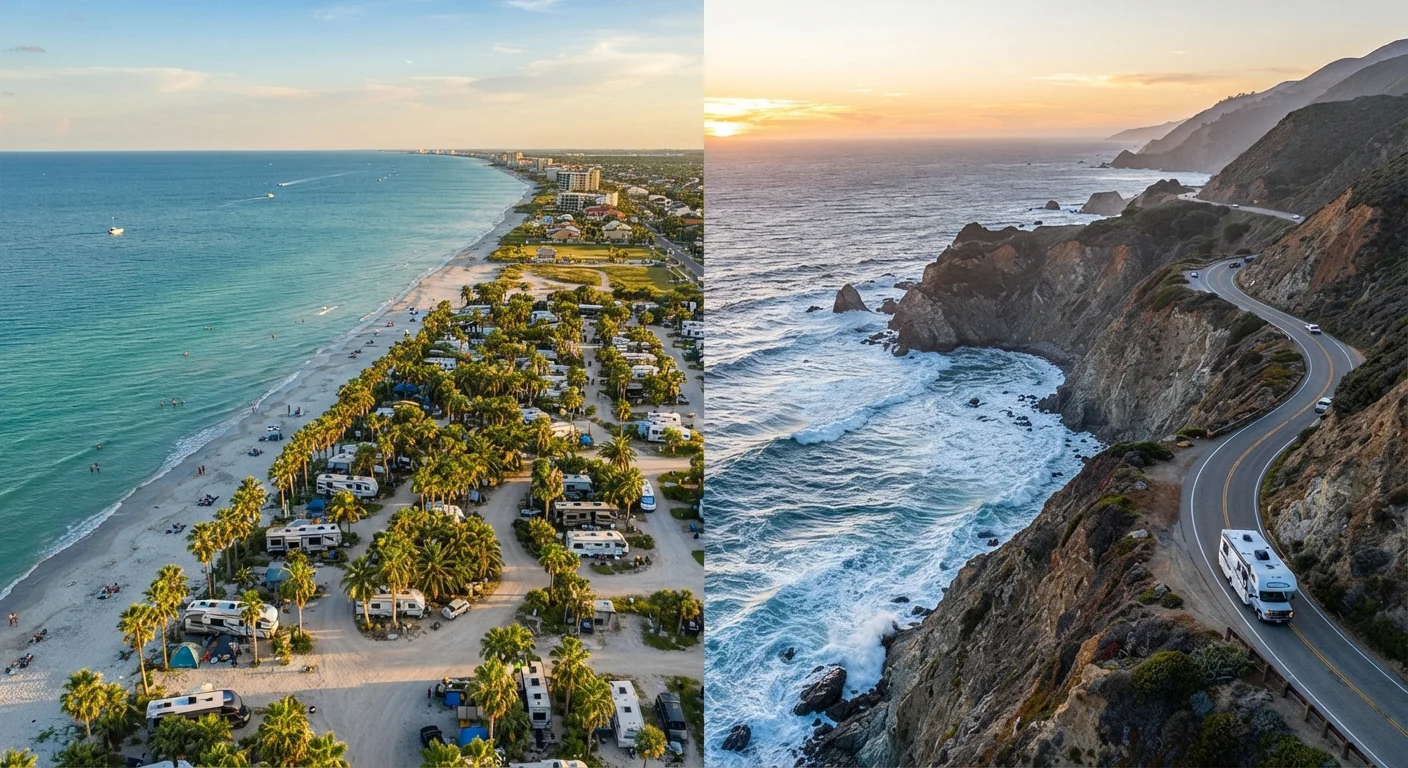
Key Takeaways
- The Gulf Coast offers flat terrain, warm winters, and abundant full-hookup RV parks suited to extended stays.
- The Pacific Coast features dramatic scenery but involves narrower roads and steeper grades that require careful route planning.
- Gulf Coast campgrounds tend to have milder weather windows from October through April, ideal for snowbirds.
- Pacific Coast campgrounds often require advance reservations months ahead, especially in California state parks.
- Both coasts offer accessible beaches, but Gulf Coast beaches are generally flatter and easier to walk.
- Your comfort priorities — climate, terrain, or scenery — should guide which coast suits your travel style.
Option A
Gulf Coast RV Camping
The warm, flat, and leisurely coastal corridor.
Best for: Seniors seeking mild weather, easy terrain, and well-developed campgrounds with full hookups along a relaxed shoreline.
Option B
Pacific Coast RV Camping
The dramatic, scenic, and adventurous coastal route.
Best for: Seniors who want breathtaking ocean scenery and cooler temperatures, and are comfortable navigating more challenging mountain coastal roads.
If you prioritize mild winters and easy driving
Gulf Coast RV Camping
The Gulf Coast corridor from Texas to Florida offers flat highways, warm winter weather, and plentiful full-hookup parks with senior-friendly amenities.
If dramatic ocean scenery is your top priority
Pacific Coast RV Camping
The Pacific Coast delivers iconic clifftop views and lush coastal forests, rewarding travelers prepared for its more demanding roads.
If you prefer extended stays over long daily drives
Gulf Coast RV Camping
Gulf Coast parks frequently offer monthly rates and snowbird communities, making them well-suited for seniors who prefer settling in one place for weeks at a time.
If you want cooler summer temperatures on the coast
Pacific Coast RV Camping
Pacific Ocean currents keep coastal California and Oregon remarkably cool in summer, offering a comfortable escape from inland heat.
If accessibility and campground infrastructure matter most
Gulf Coast RV Camping
Gulf Coast RV parks generally offer larger pull-through sites, paved pads, and a higher density of accessible facilities than many Pacific Coast state parks.
Terrain, Roads, and Getting There
The single biggest difference between these two corridors is the driving experience itself. The Gulf Coast — stretching from Brownsville, Texas, through Louisiana, Mississippi, Alabama, and into Florida's Panhandle — runs along relatively flat, well-maintained highways. Interstates and US routes parallel the shoreline for much of the route, with gentle grades and wide lanes that make towing a travel trailer or driving a Class A motorhome comparatively straightforward.
The Pacific Coast is a different story. While the scenery along California's Highway 1, Oregon's US-101, and Washington's coastal routes is extraordinary, the roads are frequently narrow, winding, and steep. Sharp switchbacks, low-clearance tunnels, and cliff-edge shoulders demand an experienced hand and a realistic awareness of your rig's dimensions. Larger RVs — generally those over 25 feet — may find certain sections of Highway 1 impractical or prohibited. For seniors who want to experience the Pacific Coast without the stress of tight roads, planning inland bypass sections and reserving Highway 1 for shorter day drives can be a sensible approach. See what Pacific Coast Highway driving actually involves before committing your rig to that iconic route.
For those weighing other route types, mountain versus flatland RV destinations offers useful context on how terrain shapes the entire travel experience.
Climate and Seasonal Timing
Climate is where the Gulf Coast earns its reputation as a snowbird haven. From October through April, temperatures along the Texas and Florida Gulf coasts typically range from the mid-50s to low 80s°F — warm enough for beach walks and outdoor dining without oppressive humidity. Summers, however, bring intense heat, high humidity, and active hurricane seasons (June through November), which most senior travelers wisely choose to avoid.
The Pacific Coast operates on a different climate logic. Central and Northern California, Oregon, and Washington coasts stay cool year-round, with summer highs commonly in the 60s°F thanks to Pacific marine currents. This makes summer a genuinely pleasant time to travel the Pacific Coast — while the Gulf Coast bakes. Winter on the Pacific Coast brings rain, particularly in Oregon and Washington, and some campgrounds reduce services or close entirely from November through March.
~1,650 mi
Gulf Coast shoreline (TX to FL Panhandle)
The Gulf Coast spans roughly 1,650 miles of coastline across five states, offering numerous RV staging options along the route.
~1,300 mi
California coastline length
California alone accounts for approximately 1,300 miles of Pacific coastline, much of it accessible only via the challenging Highway 1 corridor.
60s°F
Typical Pacific Coast summer high
Marine layer and ocean currents routinely keep summer temperatures along the central California and Oregon coasts in the 60–68°F range.
In short: the Gulf Coast is a winter escape; the Pacific Coast is a summer retreat. Many seasoned RV travelers use both — wintering on the Gulf and heading north and west for summer months.
Campground Infrastructure and Senior Accessibility
Gulf Coast RV parks, particularly those in Florida and Texas, are often purpose-built for extended stays. Expect large pull-through sites with full hookups (water, electric, sewer), paved or compacted-gravel pads, and amenities such as heated pools, shuffleboard courts, organized activities, and on-site laundry. Many cater explicitly to older adults with wide internal roads designed to accommodate big rigs and mobility-conscious layouts.
Pacific Coast campgrounds are more varied. California's state park system includes well-maintained sites at places like Carpinteria State Beach or San Simeon, but sites are often smaller and may not accommodate rigs over 35 feet. Hookups are less universal — many Pacific Coast state parks offer partial or no-hookup sites, which requires self-sufficiency (adequate tank capacity and a generator or solar setup). Reservation systems on the Pacific Coast, particularly in California, can open six months in advance and fill within hours for peak summer slots.
Booking Pacific Coast Sites Early
California State Parks' reservation system (ReserveCalifornia) and Oregon's reserveamerica.com open bookings up to six months in advance. Popular coastal campgrounds like those at Point Reyes or Cape Lookout State Park can fill within minutes of opening. Seniors planning a Pacific Coast trip should identify target sites and set calendar reminders for their exact booking-open dates. Flexibility on specific dates will significantly expand your options.
For practical guidance on adapting your setup for extended coastal stays, the Senior RV Living hub covers comfort and accessibility adaptations in detail. General RV trip planning essentials are also worth reviewing before booking either corridor.
Scenery, Pace, and the Overall Experience
Both coasts deliver genuine beauty, but in very different registers. The Gulf Coast is wide, warm, and unhurried — sugar-white sand beaches, calm Gulf waters ideal for wading or fishing, and a laid-back Southern pace that suits travelers who want to slow down and stay awhile. Communities like Rockport (Texas), Gulf Shores (Alabama), and Destin (Florida) have well-established visitor infrastructure including accessible boardwalks, seafood restaurants, and nearby medical facilities.
The Pacific Coast is cinematic in scale — towering redwoods, sea stacks rising from the surf, and fog-draped headlands create an atmosphere unlike anywhere else in the country. The trade-off is that the experience is more active and logistically demanding. Campsite hunting, road navigation, and managing without full hookups are real considerations.
| Criterion | Gulf Coast | Pacific Coast |
|---|---|---|
| Terrain & road difficulty | Flat, wide highways | Narrow, winding, steep grades |
| Best travel season | October – April | May – September |
| Full-hookup availability | Widely available | Limited at many state parks |
| Site size for large rigs | Generally accommodating | Often restrictive (under 35 ft) |
| Advance reservation needed | Moderate lead time | Months ahead for peak sites |
| Beach accessibility | Flat, easy to walk | Often steep cliffs to beach |
| Scenery style | Calm, pastoral shoreline | Dramatic, cinematic cliffs |
| Snowbird suitability | Excellent | Limited (rain, partial closures) |
For a broader look at unhurried coastal and scenic routes suited to senior travelers, America's most scenic RV routes for slower-paced exploration offers additional inspiration. If you're exploring the Gulf region specifically, RV travel in the American South provides helpful regional context.