

Key Takeaways
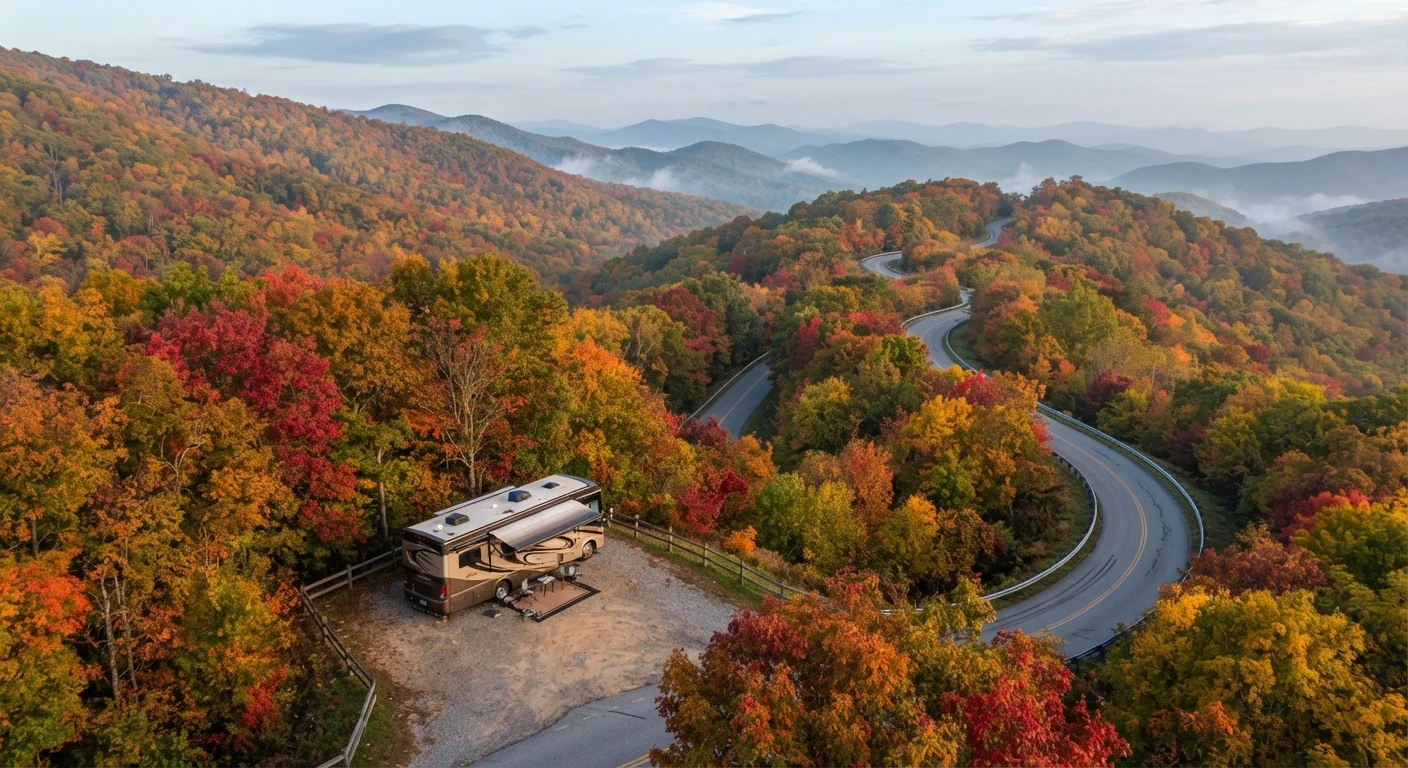
- Peak Appalachian foliage typically runs from mid-September through early November, varying by elevation.
- Full-hookup campgrounds near major scenic corridors make fall RV travel more comfortable for seniors.
- Shorter daily drives of 100 miles or less help reduce fatigue and allow time for roadside stops.
- Many Appalachian routes include level pull-through sites and accessible restroom facilities.
- Reserving campsites weeks in advance is important during peak fall color season.
Why the Appalachians Reward a Slower RV Pace
Few regions in the country match the Appalachian Mountains for sheer autumn spectacle. Stretching from northern Georgia and Alabama up through the Carolinas, Virginia, West Virginia, and into Maryland and Pennsylvania, this corridor puts on a rolling color show that lasts weeks — not days. For senior RV travelers, that extended window is a genuine advantage: there's no need to race to catch the peak.
The region's layered elevations mean foliage matures at different times depending on altitude. High-elevation areas above 4,000 feet typically turn first, usually in late September, while valley floors and lower ridgelines follow through mid-October and into early November. Planning a route that moves gradually from north to south, or from high ground to lower elevations, lets you stay inside the color window longer.
For a broader look at how the Appalachian foothills fit into Southern RV travel, see our region-by-region orientation to RV travel in the American South. If you're also considering New England's fall foliage routes by comparison, our guide to planning a stress-free fall road trip through New England offers useful context.
Check Campground Accessibility Before You Book
When researching Appalachian campgrounds for fall, ask specifically about site surface type (paved versus gravel versus grass), site length, and whether pull-through sites are available. Step-free access to restrooms and bathhouses is worth confirming directly with the campground. Many state park reservation systems now include accessibility filters that make this search easier.
Five Appalachian Foliage Routes Worth Exploring by RV
Blue Ridge Parkway: Virginia to North Carolina
At 469 miles, the Blue Ridge Parkway is the country's most visited national parkway — and one of the most RV-friendly for travelers who prefer unhurried scenery over distance covered. The parkway's two lanes wind along ridge crests between Shenandoah National Park in Virginia and Great Smoky Mountains National Park in North Carolina.
RVs up to 35 feet are generally accommodated at most pullouts and campgrounds along the route, though a few narrow tunnel approaches require detours for larger rigs — check National Park Service guidance before departure. Campgrounds such as those at Otter Creek (Virginia) and Linville Falls (North Carolina) offer level sites with easy access. Restrooms at visitor centers are accessible. The color peak along the higher Virginia sections typically arrives in early-to-mid October.
The Blue Ridge Parkway lets you follow autumn color at 45 mph through 469 miles of mountain scenery.
Skyline Drive: Shenandoah Valley, Virginia
Skyline Drive runs 105 miles through Shenandoah National Park along the crest of Virginia's Blue Ridge Mountains. Connecting directly with the northern end of the Blue Ridge Parkway, it forms a natural first leg of a south-bound foliage tour. The road averages 3,000–3,500 feet in elevation, meaning color arrives here in late September to early October.
Campgrounds within the park offer both hookup and dry-camping options; Mathews Arm and Loft Mountain campgrounds are among the larger sites with more amenities. Driving times are slow by design — the posted speed limit is 35 mph throughout — so a full traverse makes a satisfying two-day segment rather than a single long drive.
Skyline Drive's 35 mph limit and ridge-top views make it a natural slow-travel starting point for a foliage tour.
US Route 19E: Roan Mountain Corridor, Tennessee and North Carolina
The Roan Mountain corridor along US 19E offers striking high-elevation color in a less-trafficked setting than the Parkway. Roan Mountain State Park in Tennessee provides full-hookup sites with level pads and accessible bathhouses — a meaningful comfort for seniors who prefer not to rely on the RV's onboard systems for multiple nights.
The route connects easily to the town of Newland, North Carolina, and continues toward Banner Elk, both of which offer grocery access and basic services. Elevations around 6,000 feet mean this corridor reaches peak color earlier than surrounding valleys, often by late September. The roads here are two-lane state highways with moderate curves — manageable for most Class A or Class C rigs under 35 feet.
Roan Mountain's full-hookup state park campsites make it one of the most comfortable high-elevation foliage stops in the region.
US Route 129 and Cherohala Skyway: Tennessee and North Carolina
The Cherohala Skyway spans 43 miles between Tellico Plains, Tennessee, and Robbinsville, North Carolina, crossing elevations above 5,000 feet. Unlike US 129 — which passes through the tight curves of the Tail of the Dragon and is unsuitable for RVs — the Cherohala Skyway was engineered for wider vehicles and offers broad, sweeping vistas across the Cherokee and Nantahala National Forests.
Foliage along this corridor peaks in mid-to-late October. Nearby campgrounds in the Nantahala area provide a base for exploring both the Skyway and the Joyce Kilmer Memorial Forest, which contains old-growth trees with exceptional fall color. Robbinsville-area parks include sites with electric hookups and paved access roads.
The Cherohala Skyway delivers high-elevation Appalachian color on roads actually designed to accommodate RVs.
US Route 250: Highland Scenic Highway, West Virginia
West Virginia's Highland Scenic Highway follows WV Route 150 and US 250 through the Monongahela National Forest — a less-visited but rewarding foliage route in the central Appalachians. The road reaches elevations above 4,500 feet and passes through open highlands where the treeline breaks into panoramic meadow views interspersed with hardwood stands in full color.
The Pocahontas County area anchors this route, with campgrounds at Watoga State Park offering full hookups and a reputation for well-maintained facilities. Watoga, West Virginia's largest state park, also has accessible trails with paved or packed-gravel surfaces. This corridor suits travelers seeking a quieter, less-commercial fall RV experience compared to the Parkway or Smokies.
West Virginia's Highland Scenic Highway offers solitude and open-sky foliage views that more famous corridors rarely provide.
RV Size Restrictions on the Blue Ridge Parkway
The National Park Service publishes specific guidance on RV length and height restrictions at tunnels and certain campground loops along the Blue Ridge Parkway. Some tunnels in North Carolina require RVs over a set height to use marked bypass routes. Download the current parkway RV guide from the National Park Service website and review it before finalizing your route.
Planning and Pacing Your Fall Foliage Tour
Fall is the Appalachian region's busiest tourism season. Campgrounds fill weeks — sometimes months — ahead, especially at state parks along the Blue Ridge Parkway and in the Smokies corridor. Calling ahead or booking through reservation systems early is essential rather than optional.
Daily driving distance matters significantly in this region. Mountain roads, switchbacks, and stretches of the Blue Ridge Parkway itself have posted speed limits of 45 mph or lower, with no commercial vehicles permitted. That means an 80-mile drive can take two hours or more. Building in that buffer — rather than estimating highway speeds — keeps the day relaxed. Our guide to route planning strategies for senior RV travelers walks through how to structure daily mileage sensibly.
When evaluating campground options along this corridor, it helps to understand what distinguishes full-service RV parks from more rustic alternatives. Our piece on RV parks versus dispersed camping for senior travelers breaks that comparison down clearly. For additional route ideas beyond the Appalachians, America's most scenic RV routes for slower-paced exploration highlights other unhurried, visually rewarding drives across the country.
This article provides general travel planning information. Campground availability, road conditions, and foliage timing vary year to year. Always verify current conditions with park services and official sources before traveling.