

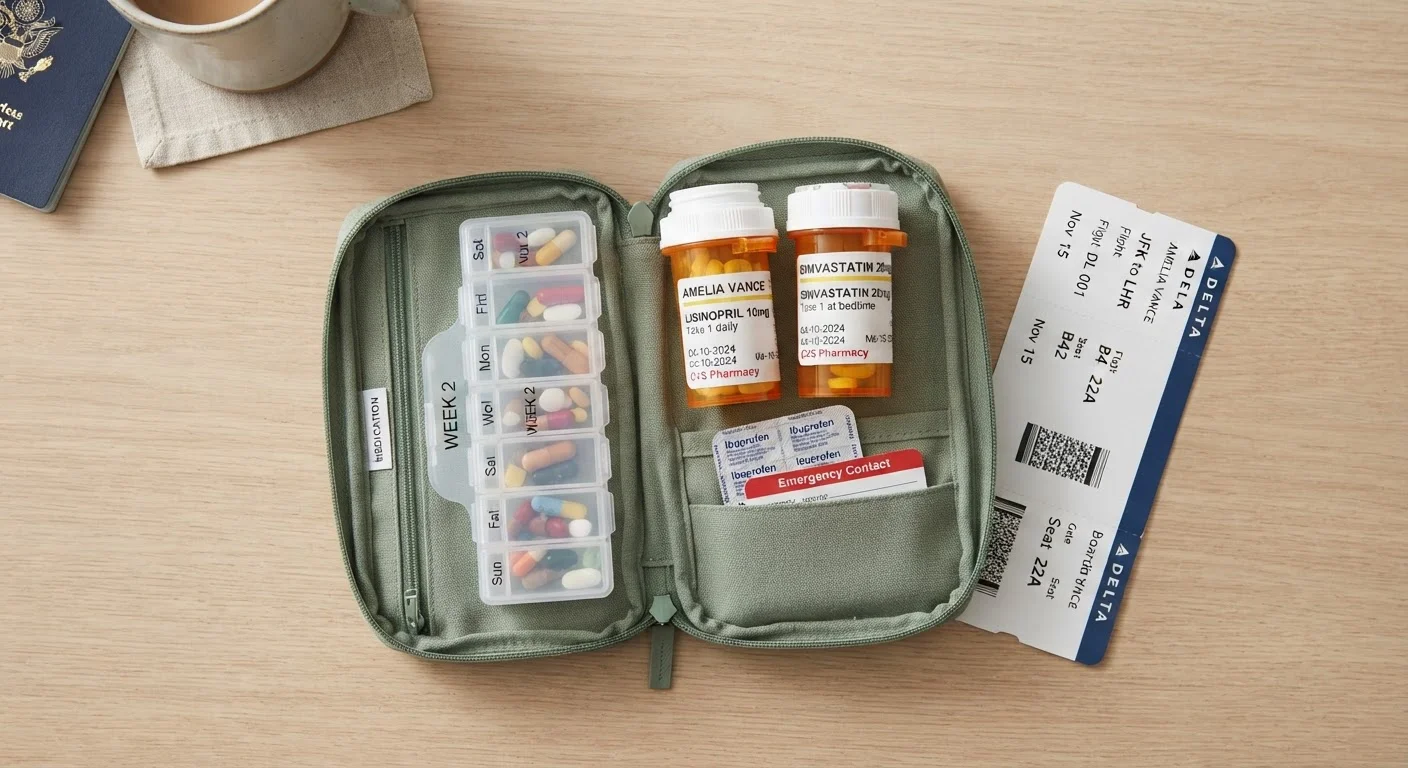
TSA Rules for Traveling With Medications
The Transportation Security Administration (TSA) allows passengers to bring both prescription and over-the-counter medications in carry-on and checked bags. There is no quantity limit, but TSA officers may need to inspect medications during screening. Understanding the rules before you reach the checkpoint makes the process far smoother.
Liquid medications — including eye drops, insulin, and liquid vitamins — are exempt from the standard 3.4-ounce (100ml) liquid rule that applies to other carry-on liquids. You should declare these items separately at the security lane and place them in a bin for X-ray inspection. Gel ice packs or frozen liquid accessories used to keep temperature-sensitive medications cool are also permitted in carry-on bags, as long as they are frozen solid at the time of screening.
TSA does not require medications to be in their original prescription bottles, though carrying them in labeled containers is strongly recommended. Airlines and destination countries may have stricter requirements, so always verify before departure. For a broader overview of flying as a senior, see our complete senior air travel planning guide.
Carry-On vs. Checked Bag: Where Medications Belong
Medical professionals and travel safety organizations consistently advise keeping all essential medications in your carry-on bag rather than checked luggage. Checked bags can be delayed, lost, or exposed to extreme temperature swings in cargo holds — none of which is acceptable for critical prescriptions.
Pack enough medication for your full trip plus a buffer of several extra days in case of unexpected delays. If your trip is long or your medication is difficult to obtain abroad, speak with your doctor or pharmacist about an extended supply before booking.
Controlled substance
A medication regulated by federal law due to its potential for misuse or dependency, such as certain pain medications or anti-anxiety drugs. These often require additional documentation when traveling, especially internationally.
Temperature-sensitive medication
Any medication that must be stored within a specific temperature range to remain effective. Insulin and certain biologics are common examples that require insulated travel cases.
TSA
The Transportation Security Administration, the U.S. federal agency responsible for security at airports. TSA sets the rules for what passengers can carry through airport security checkpoints.
Pharmacy-labeled container
The original dispensing bottle provided by a pharmacy, printed with the patient name, drug name, dosage, prescribing physician, and dispensing date.
Generic name
The non-brand, chemical name of a drug — for example, 'metformin' rather than 'Glucophage.' Including both names on your medication list helps healthcare providers and customs officials identify drugs across naming conventions.
If you also travel with medical devices such as a CPAP machine or portable oxygen concentrator, those require their own preparation. Our article on flying with a medical device covers documentation and airline communication in detail.
For tips on fitting medications alongside mobility aids and other essentials without overpacking, the guide on packing light without leaving essentials behind offers practical strategies.
Storage and Temperature Considerations
Many medications — particularly insulin, certain biologics, and some eye drops — require refrigeration or protection from heat. Airport terminals and aircraft cabins can be warm or unpredictably climate-controlled, so plan storage accordingly.
Insulated medication travel cases with reusable gel packs are widely available and keep temperature-sensitive medications within safe ranges for several hours. Always confirm the acceptable temperature window with your pharmacist and check how long your storage solution can maintain that range under real travel conditions.
~2M
Passengers screened by TSA daily in the US
TSA screens approximately 2 million passengers per day, making checkpoint preparation essential for a smooth experience.
1–2%
Checked bags reported lost or significantly delayed
Industry data consistently shows a small but real rate of bag mishandling — a key reason to keep medications in carry-on luggage.
Avoid storing medications in overhead bins during flight if the temperature there concerns you — the area under the seat in front of you is generally more consistent. Never place medications in a car trunk or in direct sunlight during ground transfers.
For general guidance on keeping medications organized across any trip — including time zone adjustments — see our resource on medication on the move.
Documentation Every Senior Traveler Should Carry
Carrying proper documentation for your medications reduces friction at security checkpoints and is essential when traveling internationally. At minimum, pack the following:
- A printed medication list — include drug names (both brand and generic), dosages, and prescribing physician contact information.
- Original prescription labels — keep at least one bottle per medication in its pharmacy-labeled container.
- A letter from your doctor — especially important for controlled substances, injectable medications, or unusually large supplies. The letter should state your diagnosis, treatment, and the medical necessity of the medication.
- Copies stored separately — keep a digital copy in your email or cloud storage and a paper copy in a different bag from the medications themselves.
If your trip crosses international borders, requirements vary significantly by country. Some medications legal in the US are restricted or controlled elsewhere. Always verify entry requirements with the destination country's embassy or consulate before travel. Our article on managing prescription medications safely while traveling abroad covers cross-border documentation in depth.
For what to discuss with your physician before departure — including fitness-to-fly letters and refill timing — see our guide on medical prep before a trip.
International Medication Rules Vary Widely
A medication that is legal and unrestricted in the United States may be a controlled or prohibited substance in another country. This applies to some common prescriptions including certain sleep aids, pain medications, and stimulants. Before any international trip, check the destination country's embassy or consulate website for their specific import rules. The U.S. State Department's travel pages also carry country-specific health advisories.
This article provides general travel information only and is not a substitute for medical or legal advice. Always consult your healthcare provider and a licensed pharmacist before traveling with prescription medications, and verify current entry requirements with official government sources for any international destination.