
Medication on the Move: Keeping Your Prescriptions Safe and Organised While Travelling

Key Takeaways
- Always carry medications in their original labelled containers to avoid delays at security or border crossings.
- Pack enough supply for your entire trip plus a buffer of several extra days in case of delays.
- Adjusting medication timing across time zones should only be done in consultation with your prescribing physician.
- Keep a written medication list — including generic names and dosages — with your travel documents at all times.
- Temperature-sensitive medications require special attention; never store them in checked luggage or a hot vehicle.
- Digital and physical document backups both serve important roles when travelling with prescriptions.
Why Medication Organisation Matters More When You Travel
Routine disruptions are the quiet enemy of good medication management. At home, familiar cues — meals, bedtime, a bathroom shelf — help you stay on schedule. Travel removes those anchors. Time zone shifts, unpredictable meal times, and the general excitement of being somewhere new can make it surprisingly easy to miss a dose or double up accidentally.
For senior travelers managing chronic conditions such as hypertension, diabetes, or heart disease, consistency is not optional — it is part of staying well. The good news is that a small amount of planning before you leave home removes most of the risk. This article walks through practical best practices so your medications travel as smoothly as you do.
This article is for general informational purposes only and is not a substitute for personalised medical advice. Always consult your doctor or pharmacist before making any changes to your medication routine, especially when travelling across time zones.
Best Practices for Carrying and Storing Medications Safely
Implementing a few straightforward habits can make a significant difference in keeping your prescriptions safe, accessible, and effective throughout your journey.
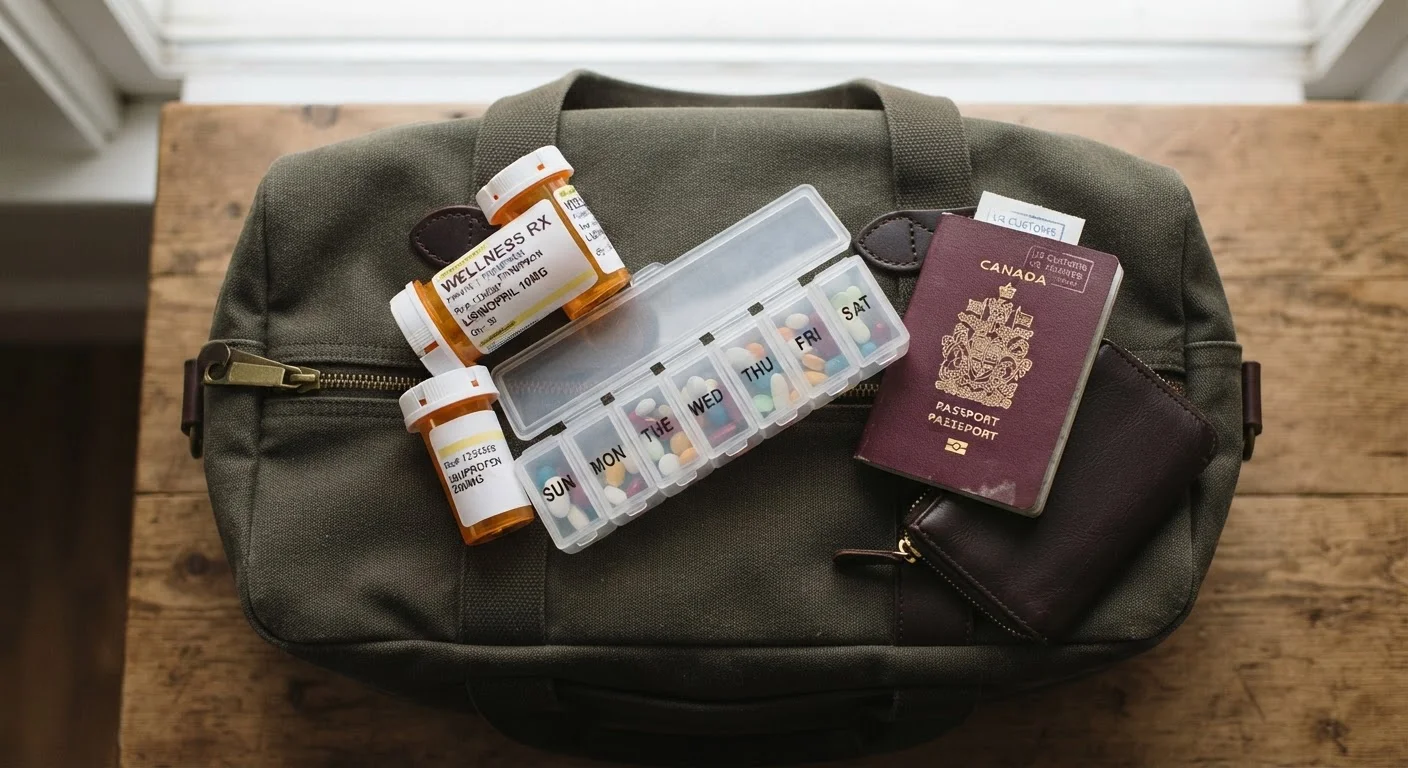
Keep all medications in original, labelled pharmacy containers throughout your journey.
Original containers carry the dispensing label, prescriber information, and lot number that security agents and healthcare providers may need to verify. Transferring pills into unmarked containers can raise questions at airport security or border crossings and may make it harder to get emergency replacements.
Pack your full supply — plus at least a five-to-seven day buffer — in your carry-on bag.
Checked luggage can be delayed, lost, or exposed to extreme temperatures in the hold. Carrying medications on your person ensures access even if your bags are rerouted. The extra supply cushion accounts for flight delays, extended stays, or difficulty locating a pharmacy at your destination.
Store temperature-sensitive medications — such as insulin — in an insulated travel case with appropriate cooling elements.
Many medications degrade rapidly when exposed to heat or freezing temperatures. A car glove box, sunny hotel windowsill, or uncooled hold can render a medication ineffective before you even reach your destination. Specialised insulated cases maintain a stable temperature range for several hours without refrigeration.
Consult your doctor before adjusting medication timing for time zone changes.
Some medications — particularly those for heart conditions, seizure management, or diabetes — have narrow timing windows where consistency is clinically important. Shifting doses arbitrarily can affect efficacy or cause side effects. Your prescribing physician can give you a safe, personalised transition schedule.
Carry a current, complete medication list in both digital and physical formats.
If you need emergency care abroad, local providers may be unfamiliar with brand names used in the US. A list that includes generic names, dosages, and your prescriber's contact information speeds up assessment and reduces the risk of harmful drug interactions from unfamiliar substitutes.
For those travelling by air, the rules around medications and air travel are worth reviewing well before your departure date, as screening procedures and carry-on requirements have specific nuances for prescription drugs.
Documentation: Your Best Travel Companion
Carrying the right paperwork can prevent a stressful situation from becoming a crisis. A written medication list — including each drug's generic name, brand name, prescribing doctor, dosage, and frequency — is invaluable if you need to seek care away from home or if your medication is questioned at a border crossing.
Ask for Generic Names on Your Medication List
Brand names for medications often differ from country to country, and a pharmacist or emergency physician abroad may not recognise the name printed on your US bottle. Always include the generic (chemical) name alongside the brand name on your written medication list. Your pharmacist can provide this information easily when you request your travel supply.
Consider maintaining both digital and physical copies of this list. Our related guidance on digital versus physical document backups explains how to balance both approaches effectively. If you are travelling internationally, check official government and destination-country sources regarding any controlled substances in your regimen, as documentation requirements vary widely.
For a thorough overview of documentation requirements across borders, see our article on travelling with prescription medications.
Quick-Start Actions Before You Leave Home
You do not need weeks of preparation — a focused session a few days before departure covers the essentials. The actions below are drawn from the broader practices in this article and are things you can check off today.
If you are planning an RV trip rather than a flight, the considerations around storage and temperature management are equally important. Our guidance on managing medications on a long RV journey addresses the specific challenges of extended road travel far from a pharmacy.