

Key Takeaways
- Consult your doctor before departure to review your medications and travel schedule.
- Carry an adequate supply plus a buffer in case of unexpected delays.
- Store temperature-sensitive medications in a dedicated cooler or insulated bag.
- Keep a printed medication list and prescription copies accessible at all times.
- Identify pharmacies along your route before you leave home.
What you will need
Why Medication Planning Matters More on an RV Trip
Long RV journeys offer seniors remarkable freedom — but that freedom comes with the practical reality of being far from your home pharmacy, your regular doctor, and the routines that normally keep medication management simple. A missed dose, a heat-damaged medication, or a prescription that runs out in a remote area can turn a relaxing trip into a stressful situation.
The good news is that with a modest amount of planning before you leave, most medication-related risks on the road are easy to manage. The steps below walk you through exactly what to prepare. For a broader look at maintaining your overall health routine while traveling by RV, see our guide to managing medications and healthcare routines in an RV.
What you will need
Weekly pill organizer (multi-compartment)
Keeps daily doses sorted and makes it easy to confirm medications have been taken.
Insulated medication cooler or travel bag
Maintains safe temperatures for insulin, biologics, or other heat-sensitive medications.
Printed medication list
Documents drug names, dosages, prescribing physician, and emergency contacts for quick reference.
Digital medication reminder app
Sends timed alerts to help you stay on schedule, especially when crossing time zones.
Small thermometer
Monitors storage temperature inside your cooler or RV cabinet to verify medications stay within safe ranges.
Talk with your doctor before you leave
Schedule a pre-trip consultation — in person or by phone — with your prescribing physician at least two to four weeks before departure. Discuss your planned route, total travel time, and any time zone changes. Ask whether your dosing schedule needs adjustment and whether any medications require special handling in warmer or colder climates. This conversation is also the right moment to request extended refills or a written letter documenting your prescriptions.
Calculate your supply and build in a buffer
Count the total days of your trip, then add at least a seven-to-ten day buffer for unexpected route changes, weather delays, or pharmacy closures. Fill all prescriptions before departure. If your insurance limits early refills, your doctor may be able to provide a brief written rationale to the insurer. Store the backup supply separately from your daily doses so it remains untouched unless truly needed.
Organise medications for daily use
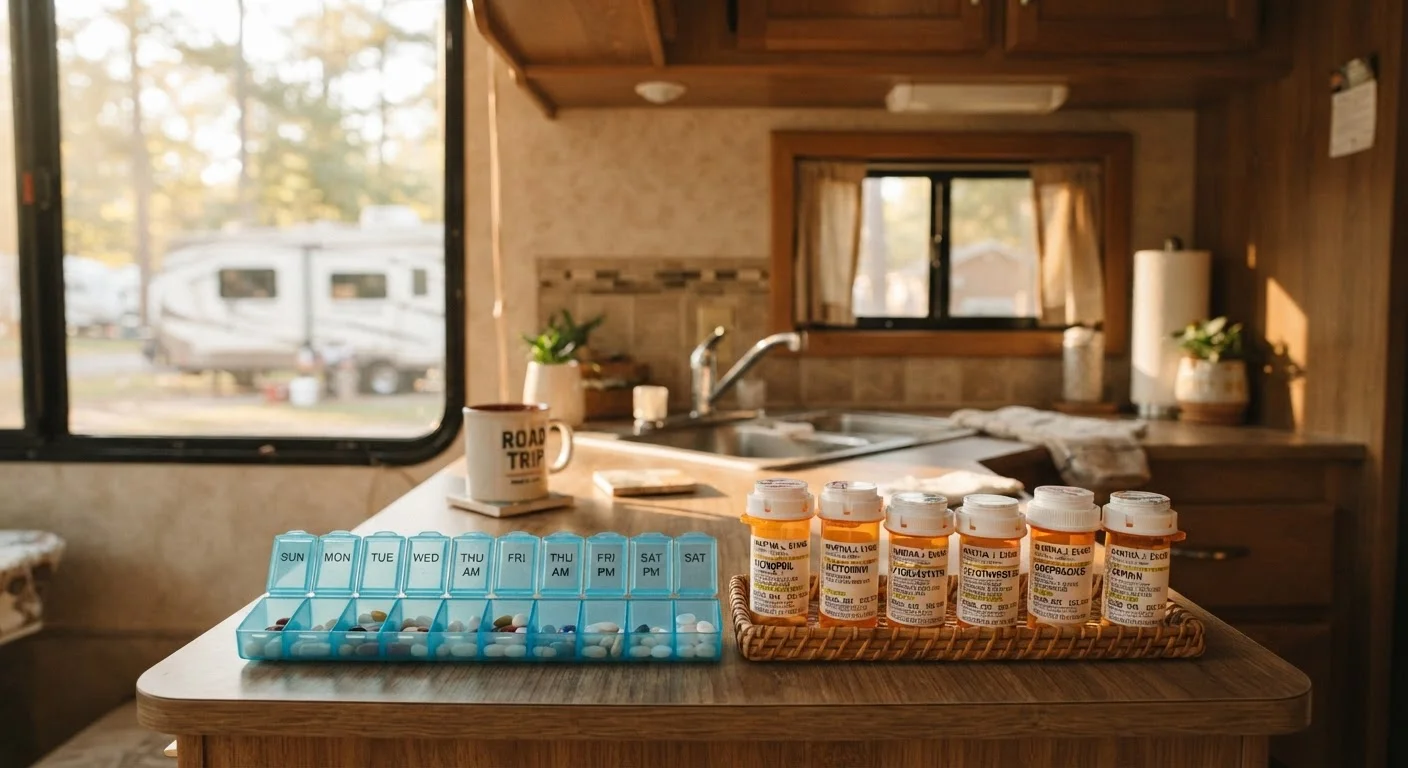
Use a clearly labeled weekly pill organizer to pre-sort your doses before the trip begins. Keep this organizer in an easily accessible location — not buried in overhead storage. If you take medications at specific times, a digital reminder app or alarm can help you stay on schedule regardless of how your day unfolds on the road. For anyone managing multiple medications, a simple daily checklist taped inside a cabinet door adds a useful visual confirmation step.
Store medications at safe temperatures
RV interiors can become extremely hot when parked in direct sun — temperatures can exceed safe storage ranges quickly. Review the storage requirements printed on each medication label or provided by your pharmacist. Most medications should be kept between 59°F and 77°F (15°C–25°C), though this varies. Use an insulated cooler or dedicated travel medication bag for heat-sensitive drugs. Never leave medications on a dashboard or in a glove compartment. A small thermometer inside your storage area lets you verify conditions at a glance.
Identify pharmacies along your route
Before departure, map out pharmacy locations at key stops along your planned route. National and regional pharmacy chains often allow prescription transfers between locations, but policies differ — confirm this with your home pharmacy in advance. Note hours of operation, particularly in rural areas where options may be limited. Save a few pharmacy contact numbers in your phone so you are not searching from scratch if an issue arises mid-trip.
Keep documentation accessible
Prepare a printed medication list that includes each drug's generic and brand name, dosage, frequency, prescribing doctor's name and contact information, and your pharmacy's phone number. Keep one copy in your everyday bag and a second copy stored separately in the RV. If you carry original prescription bottles, they serve as documentation themselves. For controlled substances in particular, carrying the original labeled bottle helps avoid complications if questions arise at a weigh station or elsewhere.
Staying on Track and Knowing When to Seek Help
Even the most thorough preparation cannot cover every scenario. If you notice that a medication has been stored outside its recommended temperature range, contact your pharmacist before continuing to use it — compromised medications may be less effective or, in rare cases, harmful. Similarly, if you miss doses due to travel disruption, do not double up without first checking with your doctor or pharmacist, as this guidance varies significantly by medication type.
Check In With Your Doctor Remotely
Many physicians now offer telehealth appointments, which means you can have a quick medication check-in even while parked at a campsite with cell service. Before your trip, ask your doctor whether remote consultations are available during your travel window. Having this option confirmed in advance adds a valuable safety net for the road.
Crossing multiple time zones adds another layer of complexity, particularly for medications that must be taken at precise intervals. Your doctor can advise on how to shift dosing times gradually or whether the schedule can remain fixed to your home time zone for the duration of the trip. For detailed guidance on how time zone changes affect dosing, the Medication on the Move article covers this topic thoroughly.
If you experience a health concern mid-trip that you believe is related to your medications, urgent care clinics are available in most mid-sized towns. The medication documentation you prepared in Step 6 will be especially useful in those settings. For additional travel health and safety strategies, explore our Travel Health Tips hub and Travel Safety Tips hub.
This article is for general informational purposes only and does not constitute medical advice. Always consult a qualified healthcare professional regarding your specific medications, health conditions, and travel plans before making any changes to your medication routine.