

Key Takeaways
- Accessible cabin availability is limited — book early and confirm features in writing before sailing.
- Gangway and tender boat access at ports can vary significantly, sometimes preventing wheelchair users from disembarking.
- Shore excursion accessibility must be researched independently; cruise-operated tours vary in what they can accommodate.
- Newer ships generally offer better accessibility infrastructure, but no vessel is universally barrier-free.
- Always consult your healthcare provider before cruising, particularly regarding medical support onboard.
Wide corridors and elevator access on modern ships
Ships built in recent years typically feature corridor widths and elevator dimensions that comfortably accommodate standard and power wheelchairs, allowing for relatively independent navigation across most public areas.
Accessible cabins with roll-in showers available
Designated accessible staterooms on major cruise lines generally include roll-in showers, fold-down shower seats, grab bars, and lowered fixtures — features that are difficult to guarantee in most hotel rooms.
Smooth, level deck surfaces in most onboard areas
Interior and many exterior deck surfaces on modern vessels are designed to minimize thresholds and transitions, reducing the everyday friction that wheelchair users commonly encounter in older buildings and transport hubs.
All meals and entertainment accessible from the ship
On days when port access is limited or inadvisable, the ship itself offers a full range of dining, entertainment, and social activities — making it possible to have a full, enjoyable day without leaving the vessel.
Some cruise lines offer dedicated accessibility coordinators
Certain cruise operators maintain guest accessibility services teams who can assist with pre-voyage planning, cabin selection, and onboard arrangements — reducing the guesswork involved in preparing for the trip.
Accessible cabins are scarce and book out quickly
Most ships allocate only a small number of staterooms as fully accessible, and these fill faster than standard cabins. Late bookers may find no compliant options available on their preferred sailing.
Tender ports can make disembarkation impossible
When ships anchor offshore and use small shuttle boats to reach land, wheelchair access is typically not feasible. Some itineraries include multiple tender ports, which can significantly reduce a wheelchair user's time ashore.
Older vessels may not meet current accessibility standards
Ships built before modern accessibility guidelines were adopted may have narrower doors, limited elevator access, or accessible cabins that fall short of what newer vessels offer — making ship-specific research essential.
Shore excursion accessibility is inconsistently documented
Excursion descriptions frequently omit meaningful detail about terrain, vehicle type, or restroom accessibility. Wheelchair users often need to contact operators directly to get accurate information before committing.
Many popular port destinations have significant terrain barriers
Cobblestone old towns, hillside villages, and historic sites with uneven surfaces are common at popular cruise ports, particularly in the Mediterranean, limiting where wheelchair users can independently explore.
Gangway conditions can change unpredictably with tides
Even at pier-side docking, the angle and configuration of gangways can shift depending on tidal changes, occasionally making access more challenging than anticipated on embarkation or disembarkation day.
Our Verdict
Cruising can be a genuinely comfortable and rewarding experience for wheelchair users — but only when expectations are grounded in reality and preparation is thorough. The onboard environment often exceeds expectations, while port accessibility frequently falls short. Gaps between what's promised and what's delivered are real, so verifying every detail before you book is essential.
Wheelchair users who research accessible cabin features carefully, choose itineraries with pier-side docking where possible, and are comfortable with some flexibility when port conditions don't cooperate.
The Onboard Experience: Better Than You Might Expect
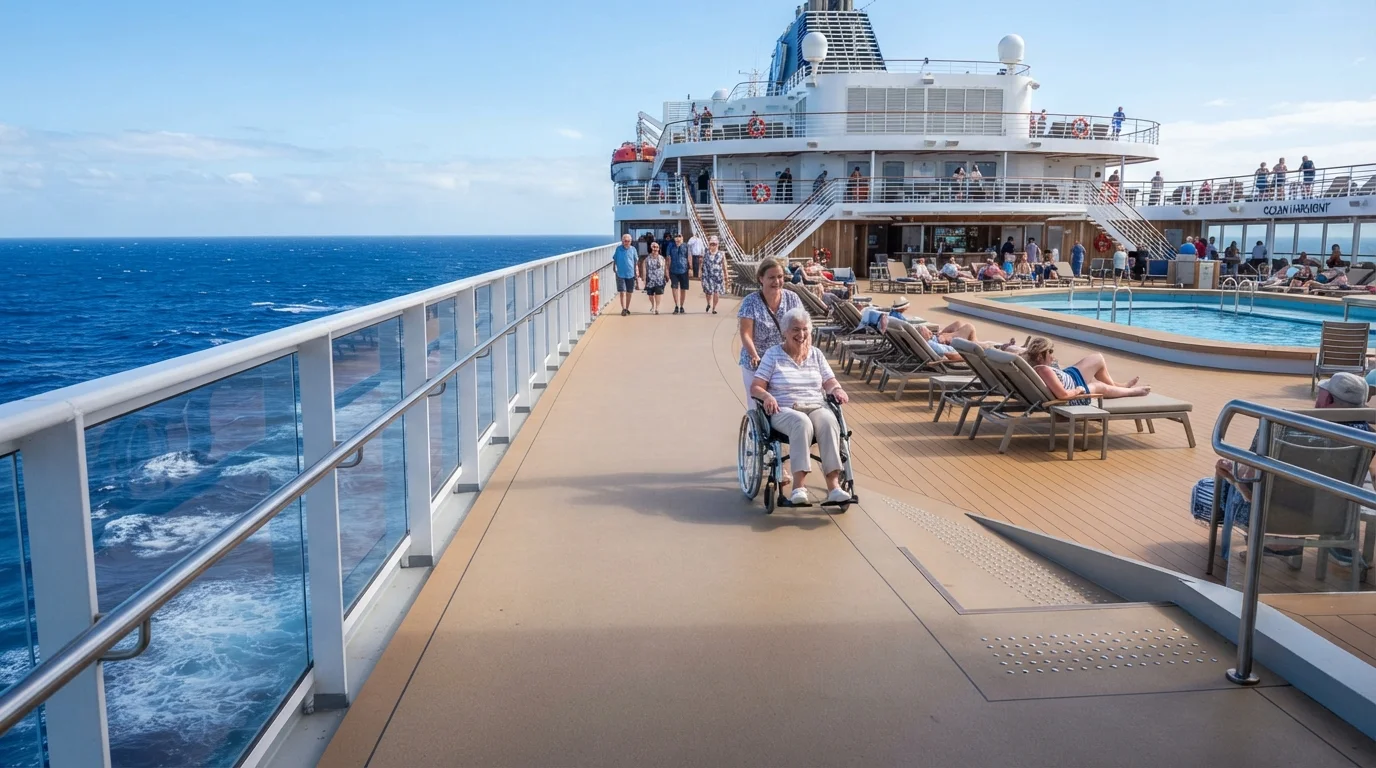
Modern cruise ships — particularly those built or refitted within the last decade — are among the more accessible large travel environments available to wheelchair users. Wide corridors, elevator access to most decks, roll-in showers, lowered closet rods, and threshold-free cabin entries are now standard features in designated accessible staterooms. Many ships also offer pool lifts, accessible dining venues, and smooth deck surfaces that make independent navigation genuinely manageable.
That said, accessible cabins are limited in number on every vessel, and they are in high demand. Booking as early as possible — ideally six to twelve months ahead — and confirming exact cabin specifications in writing with the cruise line is not optional; it is essential. Request a detailed layout diagram of the cabin and bathroom, including turning radius measurements, before committing. See our accessibility features checklist for the specific questions worth asking at this stage.
Wide corridors and elevator access on modern ships
Ships built in recent years typically feature corridor widths and elevator dimensions that comfortably accommodate standard and power wheelchairs, allowing for relatively independent navigation across most public areas.
Accessible cabins with roll-in showers available
Designated accessible staterooms on major cruise lines generally include roll-in showers, fold-down shower seats, grab bars, and lowered fixtures — features that are difficult to guarantee in most hotel rooms.
Smooth, level deck surfaces in most onboard areas
Interior and many exterior deck surfaces on modern vessels are designed to minimize thresholds and transitions, reducing the everyday friction that wheelchair users commonly encounter in older buildings and transport hubs.
All meals and entertainment accessible from the ship
On days when port access is limited or inadvisable, the ship itself offers a full range of dining, entertainment, and social activities — making it possible to have a full, enjoyable day without leaving the vessel.
Some cruise lines offer dedicated accessibility coordinators
Certain cruise operators maintain guest accessibility services teams who can assist with pre-voyage planning, cabin selection, and onboard arrangements — reducing the guesswork involved in preparing for the trip.
The Realistic Gaps: Where Challenges Arise
The most significant and least predictable barrier for wheelchair users is port access. When a ship anchors offshore and passengers travel to land by small tender boats, wheelchair access is rarely possible. Even at ports with docking piers, gangway angles can vary with tide levels and may not accommodate all mobility equipment on a given day. Cruise lines are generally candid about tender-only ports in their itinerary documentation, so reviewing this in advance allows travelers to plan accordingly rather than face disappointment on the day.
Older vessels present more structural limitations — narrower corridors, fewer elevator banks, and accessible cabins that may not fully meet current standards. If a ship was not built with accessibility as a design priority, retrofitting has limits. Researching a specific vessel, not just a cruise line's general policy, is the more reliable approach. Our guide to onboard mobility explains what to look for in a ship's layout before you book.
Accessible cabins are scarce and book out quickly
Most ships allocate only a small number of staterooms as fully accessible, and these fill faster than standard cabins. Late bookers may find no compliant options available on their preferred sailing.
Tender ports can make disembarkation impossible
When ships anchor offshore and use small shuttle boats to reach land, wheelchair access is typically not feasible. Some itineraries include multiple tender ports, which can significantly reduce a wheelchair user's time ashore.
Older vessels may not meet current accessibility standards
Ships built before modern accessibility guidelines were adopted may have narrower doors, limited elevator access, or accessible cabins that fall short of what newer vessels offer — making ship-specific research essential.
Shore excursion accessibility is inconsistently documented
Excursion descriptions frequently omit meaningful detail about terrain, vehicle type, or restroom accessibility. Wheelchair users often need to contact operators directly to get accurate information before committing.
Many popular port destinations have significant terrain barriers
Cobblestone old towns, hillside villages, and historic sites with uneven surfaces are common at popular cruise ports, particularly in the Mediterranean, limiting where wheelchair users can independently explore.
Gangway conditions can change unpredictably with tides
Even at pier-side docking, the angle and configuration of gangways can shift depending on tidal changes, occasionally making access more challenging than anticipated on embarkation or disembarkation day.
Shore Excursions: Manage Expectations Carefully
Shore excursions represent the area where the gap between marketing and reality is widest for wheelchair users. Cruise-operated excursion descriptions do not always clearly signal which tours involve cobblestone streets, steep gradients, or uneven terrain. Many of the most-visited Mediterranean, Caribbean, and Northern European ports include significant accessibility obstacles at the destination itself — not just at the dock.
Wheelchair users benefit from contacting excursion providers directly before sailing to ask specific questions about surface types, vehicle accessibility, and restroom availability. Some destinations, including several popular Mediterranean ports, have old-town centers that are effectively inaccessible for wheeled mobility devices. Get a realistic picture of Mediterranean port accessibility before including them in your itinerary. For a structured approach to evaluating excursions, see shore excursion planning for limited mobility.
~2%
Accessible cabins as share of total ship capacity
Industry accessibility consultants have noted that accessible staterooms typically represent only around 2% of a ship's total cabin inventory, underscoring the importance of early booking.
30%+
Caribbean itinerary ports relying on tender access
A review of popular Caribbean cruise itineraries suggests that a notable proportion of stops require tender boat transfers, which generally cannot accommodate wheelchairs.
Health and Practical Planning Before You Sail
Wheelchair users managing chronic health conditions should review onboard medical capabilities with their own healthcare provider well in advance. Cruise ships carry medical staff and basic equipment, but they are not hospitals — and the level of care varies between vessels. What cruise ships actually offer for chronic conditions provides a grounded overview of what to verify with both your doctor and the cruise line before departure.
Travel insurance that covers pre-existing conditions and includes medical evacuation is a practical consideration for any senior traveler, and particularly for those with mobility needs. Policy terms and coverage vary widely — reading the actual policy document and consulting a licensed insurance adviser before purchasing is strongly recommended. As a general principle, do not assume standard travel insurance automatically covers all scenarios relevant to your health situation.
Verify With the Cruise Line Directly
Accessibility features described on booking websites are not always current or ship-specific. Before finalizing any reservation, contact the cruise line's accessibility services department directly and request written confirmation of the cabin layout, bathroom dimensions, and any mobility equipment policies. This documentation is also useful if a discrepancy arises once you board.
This article is for general informational purposes only and does not constitute medical advice. Always consult a qualified healthcare professional regarding your personal health needs before traveling.