

Key Takeaways
- Mattress support and bed height are the two highest-impact changes in an RV bedroom.
- Clear floor paths from bed to bathroom significantly reduce nighttime fall risk.
- Blackout curtains and temperature management improve sleep depth in campground settings.
- A bedside grab bar and reachable lighting make mornings safer and more manageable.
- Strategic storage placement reduces bending and reaching at the start of every day.
What you will need
Why the RV Bedroom Deserves Careful Attention
For senior RV travelers, the bedroom isn't just where you sleep — it's where your day begins and your recovery from long drives happens. Poor sleep compounds fatigue, affects balance, and makes every subsequent task harder. At the same time, the compact nature of most RV bedrooms introduces real physical challenges: narrow floor paths, low or high bed platforms, limited lighting, and thin mattresses that prioritize packing size over body support.
The good news is that meaningful improvements don't require major renovation. Most changes are low-cost, reversible, and achievable in an afternoon. This guide walks through the specific steps to take, in a practical order, so you can set up a sleeping space that supports both better rest and safer, easier mornings.
For a broader look at RV modifications that improve daily comfort, the guide to adapting your RV for comfort as you age covers flooring, lighting, and bathroom adaptations beyond the bedroom. And if you're still evaluating which RV floor plan to use, RV layouts for older adults with mobility considerations can help you choose a starting point with the best baseline access.
What you will need
Measuring tape
Measure bed height, floor clearance, and aisle width to plan safe layouts and additions.
Mattress topper or replacement mattress
Improve surface support and pressure relief on the existing RV mattress platform.
Portable bed rail or grab bar
Provide a stable handhold when transitioning from lying down to sitting or standing.
Blackout curtains or window coverings
Block exterior light from campground fixtures and early sunrise to improve sleep continuity.
Motion-activated night light
Illuminate the path from bed to bathroom without requiring fumbling for a switch in the dark.
Non-slip rug or mat
Anchor beside the bed to provide traction on smooth flooring when standing up.
Small step stool with handle
Bridge the gap if the bed sits higher than a comfortable step-up height.
Step-by-Step: Configuring Your RV Bedroom
Follow these steps in order — assessment first, then structural changes, then safety additions, then environmental tuning. Each builds on the last.
Assess Your Current Sleeping Setup
Before making any changes, walk through the bedroom as if it were the middle of the night. Note where the light switches are, how wide the path to the bathroom is, and how high or low the mattress sits. Sit on the edge of the bed and observe whether you can place both feet flat on the floor — this matters when standing up. Identify anything you currently bump into, trip over, or strain to reach.
Optimize Mattress Support and Bed Height
Most stock RV mattresses prioritize slim profiles over support, which can cause back stiffness and disrupted sleep. A quality mattress topper — particularly one with memory foam or latex — can add meaningful pressure relief without requiring a full replacement. If your bed platform is too low, a set of bed risers can bring it to a height where your knees sit at roughly a 90-degree angle when seated at the edge, making it easier to stand without straining.
If the bed is too high, a sturdy step stool with a side handle closes the gap safely. For context on how mattress firmness and surface materials affect sleep in travel settings, see what room features improve sleep quality for older travelers.
Install a Bedside Grab Bar or Rail
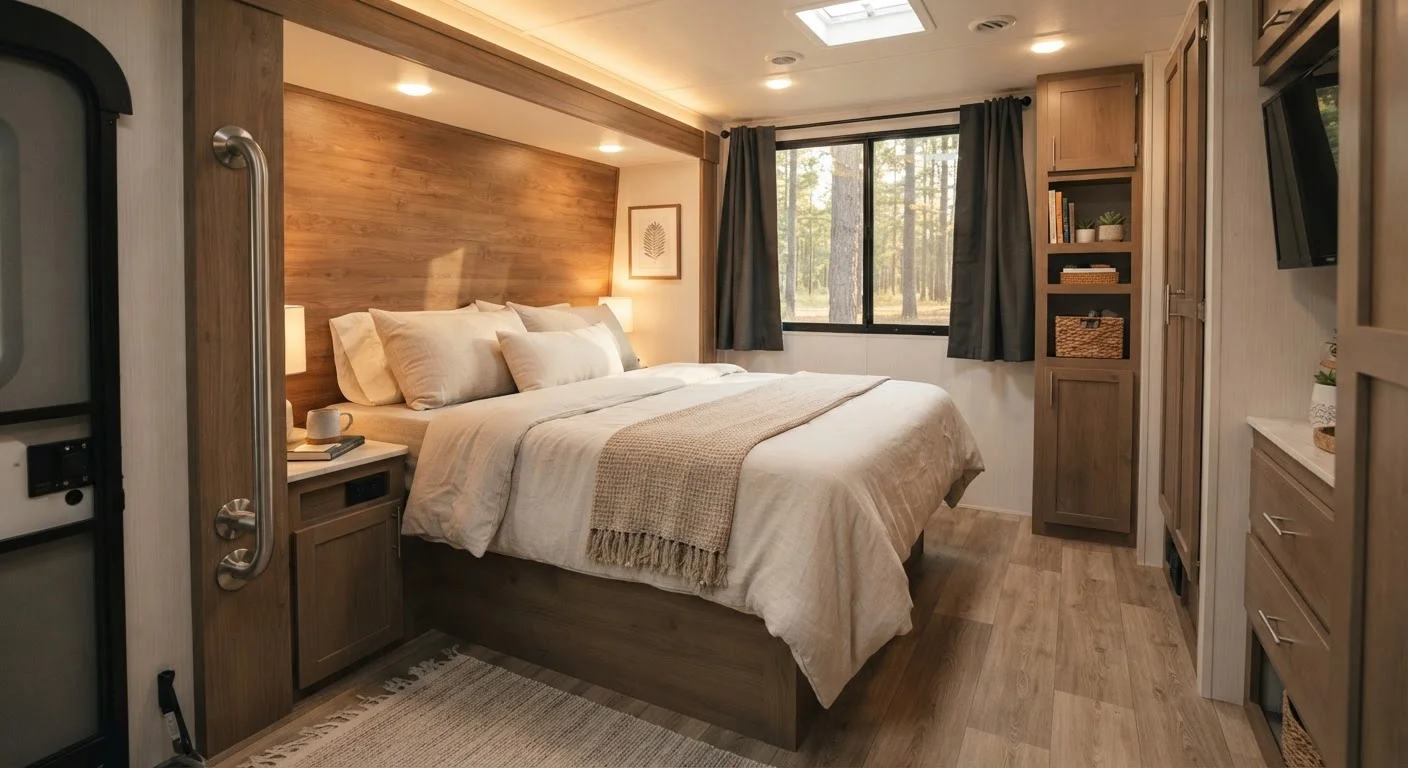
A portable bed rail that slots between the mattress and platform — or a freestanding grab bar anchored to the wall — gives you a firm handhold when transitioning from lying down to seated, and from seated to standing. This is especially useful after nighttime bathroom visits when you're moving in low light and may not be fully alert. Confirm that any rail you use is rated for your weight and is secured according to the manufacturer's instructions.
Clear and Illuminate the Nighttime Path
The route from bed to bathroom should be completely clear of bags, cords, shoes, or furniture edges at all times. In an RV, floor space is limited, so be deliberate: designate specific storage spots for items that would otherwise drift onto the floor. A motion-activated night light plugged into an outlet along the path removes the need to fumble for switches and provides enough light to walk safely without fully waking you. Peel-and-stick LED strips along the base of the cabinet run at low brightness and are an effective, low-cost option.
Control Light and Temperature for Better Sleep
Campgrounds often have overhead lighting, neighboring RVs with lit awnings, and early morning sun that penetrates thin factory window coverings. Adding blackout curtains — or blackout-lined panels that clip or velcro over existing coverings — substantially improves sleep continuity. Temperature also matters: sleeping environments that are slightly cool (roughly 65–68°F for many people) tend to support deeper sleep. Use your RV's climate system or a small fan to manage this, and consider a lightweight blanket you can easily add or remove during the night.
Organize Morning Essentials Within Easy Reach
The first few minutes after waking are often when stiffness peaks. Reduce unnecessary movement by keeping frequently needed items — glasses, medications, a water bottle, your phone — at arm's reach on a bedside shelf, caddy, or mounted organizer. Avoid storing these things in overhead compartments or at floor level. Clothing for the next day can be laid out the night before on a nearby hook or the foot of the bed. For a broader look at organizing RV gear with mobility in mind, see the senior RV packing guide.
Think in Terms of a Nighttime Trial Run
After making any changes, do a deliberate walk-through in the dark — or with your eyes only partially open — to simulate a real nighttime movement. This reveals hazards that look fine in daylight but become problems at 2 a.m. Make it a habit each time you reconfigure the space at a new campsite.
Non-Slip Flooring Is Not Optional
Smooth RV flooring combined with grogginess and low light is a serious fall risk. A non-slip mat beside the bed — one that lays flat and won't bunch or slide — provides grip when you first stand. Check that it lies completely flat before each night's sleep, especially after cleaning the floor.
Consult Your Doctor About Sleep or Mobility Changes
If you're experiencing significant sleep disruption, increased nighttime bathroom trips, or new difficulty with mobility after waking, discuss these with a qualified healthcare professional before assuming environmental fixes are sufficient. Some changes in sleep patterns or morning stiffness have underlying causes worth evaluating. The adjustments in this guide are general comfort and safety measures, not substitutes for medical advice.
Once your bedroom is configured for safe, comfortable nights on the road, you'll find that the rest of each travel day feels more manageable too. For those planning multi-week trips, the end-to-end resource for senior RV living addresses how rest and recovery fit into the broader rhythm of extended RV travel.