

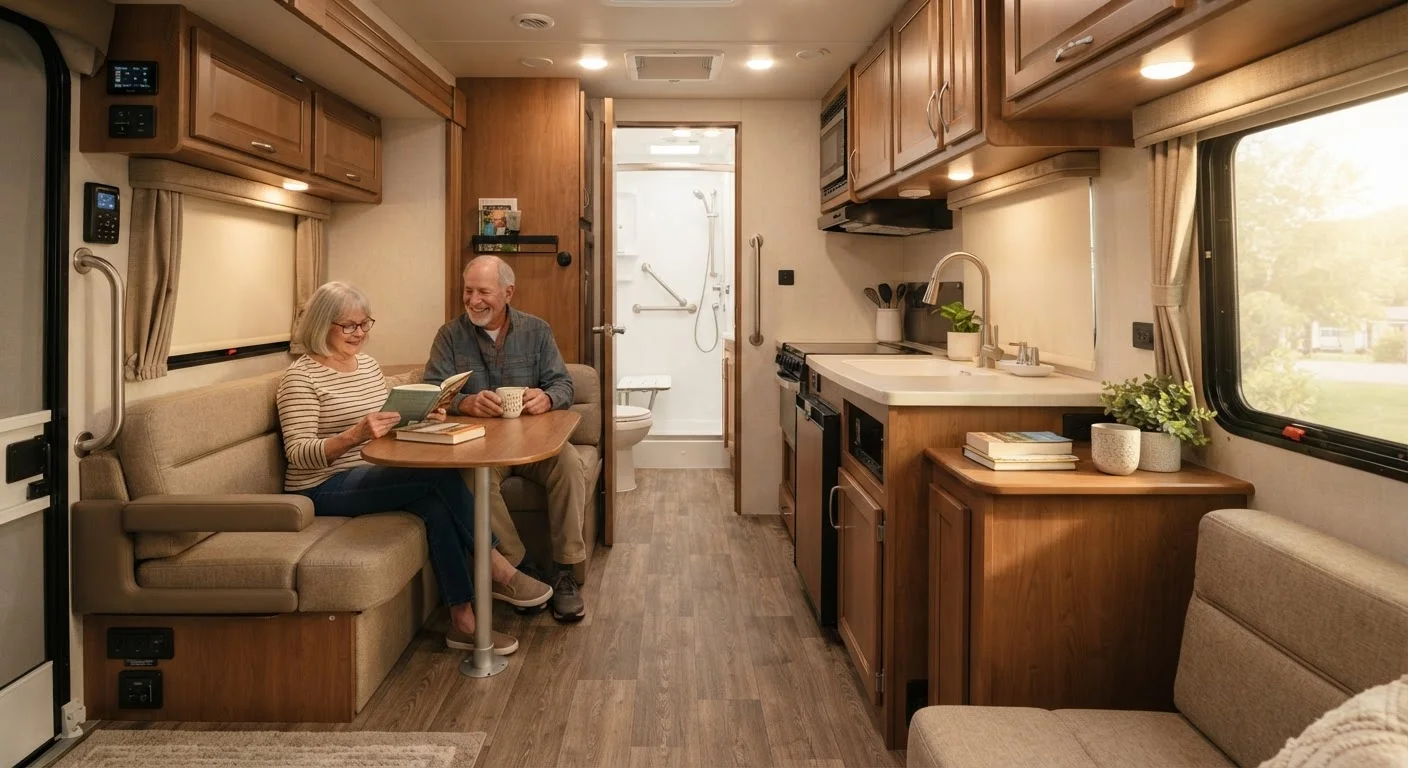
Key Takeaways
- Non-slip flooring and grab bars are among the highest-impact safety upgrades for senior RV travelers.
- Bathroom modifications — including raised toilet seats and walk-in shower aids — reduce fall risk significantly.
- Lighting improvements and lever-style hardware require minimal installation effort but deliver major daily benefits.
- Most RV modifications can be completed affordably without permanent structural changes to your vehicle.
- Combining smart layout choices with targeted modifications creates the safest possible RV environment for aging in place.
Why RV Modifications Matter More as You Age
An RV that worked perfectly at 55 may feel awkward or even hazardous at 70. Narrow aisles, slippery bathroom floors, low toilet seats, and dim overhead lights are design choices made for the general market — not specifically for older adults navigating daily life on a moving vehicle. The good news is that targeted modifications can close most of those gaps without a full renovation.
This guide walks through the most practical changes senior RV travelers make, ranked by the difference they're likely to make to your safety and day-to-day comfort. For a broader picture of how layout choice interacts with these upgrades, see RV layouts that work best for older adults. You may also want to review the senior RV living end-to-end resource for context on the full spectrum of planning considerations.
Install Grab Bars in the Bathroom and Entry
Grab bars are the single most effective modification you can make. In a compact RV bathroom, the shift from toilet to shower to sink happens in tight quarters — and wet surfaces amplify fall risk. A sturdy grab bar mounted beside the toilet and another along the shower wall gives you a reliable anchor point for every transition.
Entry grab bars mounted just inside or outside the main door help enormously when stepping up or down from the vehicle, especially after a long drive when legs may feel stiff. Look for bars rated to hold at least 250 pounds and anchored into wall studs or with reinforcing backing plates — not just surface-mounted into thin paneling.
Grab bars beside the toilet and shower are the most impactful single modification you can make.
Replace Slippery Flooring with Non-Slip Surfaces
Standard RV flooring — laminate, vinyl plank, or linoleum — becomes dangerously slick when wet. Replace bathroom flooring with textured, water-resistant non-slip material, or at minimum add washable non-slip bath mats secured with suction cups or non-skid backing. In the kitchen and main living area, consider anti-fatigue mats at standing work zones.
Loose rugs with curling edges are a tripping hazard and should be removed entirely. If you want additional floor coverage, use low-profile, non-slip-backed runners that lie completely flat.
Loose rugs are a leading trip hazard in RVs — remove them or replace with secured, flat non-slip options.
Add a Raised Toilet Seat or Comfort-Height Commode
Standard RV toilets sit lower than most residential models, making lowering and rising from the seat harder on hips and knees. A raised toilet seat — typically adding 2 to 4 inches of height — can be fitted over the existing fixture without any plumbing work. Models with integrated armrests provide additional leverage for standing.
Confirm compatibility with your RV's toilet model before purchasing, as RV and residential toilet bowl shapes differ. Some seniors opt to replace the toilet entirely with a taller residential-style unit if the plumbing connection allows.
A raised toilet seat adds inches of height that meaningfully reduce strain on hips and knees every day.
Improve Interior Lighting Throughout
Many RVs ship with minimal overhead lighting — fine for younger eyes, inadequate for seniors who may have reduced night vision or contrast sensitivity. Replacing standard bulbs with bright LED fixtures in the kitchen, bathroom, and bedroom makes a noticeable difference. Under-cabinet LED strips in the kitchen provide focused task lighting without glare.
Night lights plugged into 12V outlets along the floor path between bedroom and bathroom are a low-cost, high-value addition. Motion-activated versions mean you don't need to fumble for a switch during middle-of-the-night trips.
Motion-activated floor-level night lights eliminate one of the most common causes of nighttime falls in RVs.
Switch to Lever-Style Door and Cabinet Hardware
Round knobs require gripping and twisting — a motion that becomes difficult with arthritis or reduced hand strength. Lever-style door handles and D-ring cabinet pulls can be operated with a closed fist or even a wrist, requiring far less hand dexterity. This upgrade is especially valuable in the kitchen, bathroom, and RV entry door.
Replacement hardware is widely available and typically installs with a screwdriver in minutes. Choose hardware with a finish that contrasts with cabinetry color so handles are easy to locate at a glance.
Lever handles require no grip or twist, making them far easier to use for those with arthritis or reduced hand strength.
Install a Handheld Showerhead
A fixed showerhead in an RV's compact shower stall requires awkward maneuvering to rinse fully. A handheld showerhead on a long hose allows bathing while seated on a shower stool — a significant safety advantage for anyone with balance concerns. Many models attach directly to the existing shower arm without tools.
Pair this with a fold-down or portable shower stool. Seated bathing reduces the time spent standing on a wet surface and lowers fatigue significantly, particularly after physically active days outdoors. Check the travel health tips hub for additional wellness strategies relevant to life on the road.
A handheld showerhead paired with a shower stool allows safe, seated bathing — a major comfort and safety upgrade.
Add Step Stools and Bed Rails for Safe Transitions
RV beds are often elevated on storage platforms, making getting in and out a physical challenge. A sturdy, non-slip bed step stool placed consistently at the same side of the bed provides a reliable intermediate step. Portable bed rails — designed to tuck under the mattress — offer a handhold when shifting from lying down to sitting up.
Similarly, a small step stool near overhead storage compartments reduces the need for reaching or standing on tiptoe. Combined with good lighting, these transitions become safer and less physically taxing across the board.
A dedicated bed step stool and bed rail make one of the most-repeated daily transitions significantly safer.
Planning Your Modifications Wisely
Not every modification needs to happen at once. Start by identifying the two or three areas where you feel least confident — bathroom safety, entry and exit, or lighting — and address those first. Many upgrades cost under $100 and install in under an hour. Before purchasing anything, verify measurements inside your specific RV model, as dimensions vary considerably between floorplans.
Test Modifications Before You Hit the Road
After installing any grab bar, non-slip mat, or hardware change, test it under realistic conditions — wet hands, low light, or after physical exertion — before departing on a trip. A modification that works well in a driveway may need adjustment once you're in a campground. Build in a short shakedown trip close to home to identify anything that needs refinement.
If your health or mobility situation is changing more broadly, it's also worth reading when RV living may need to be reconsidered — honest planning includes knowing when adaptations reach their limits. For packing the right support items to complement your modified space, the senior RV packing guide offers a practical checklist built around mobility and comfort needs.