
Senior RV Packing Guide: Comfort Essentials, Mobility Aids, and What to Leave Behind

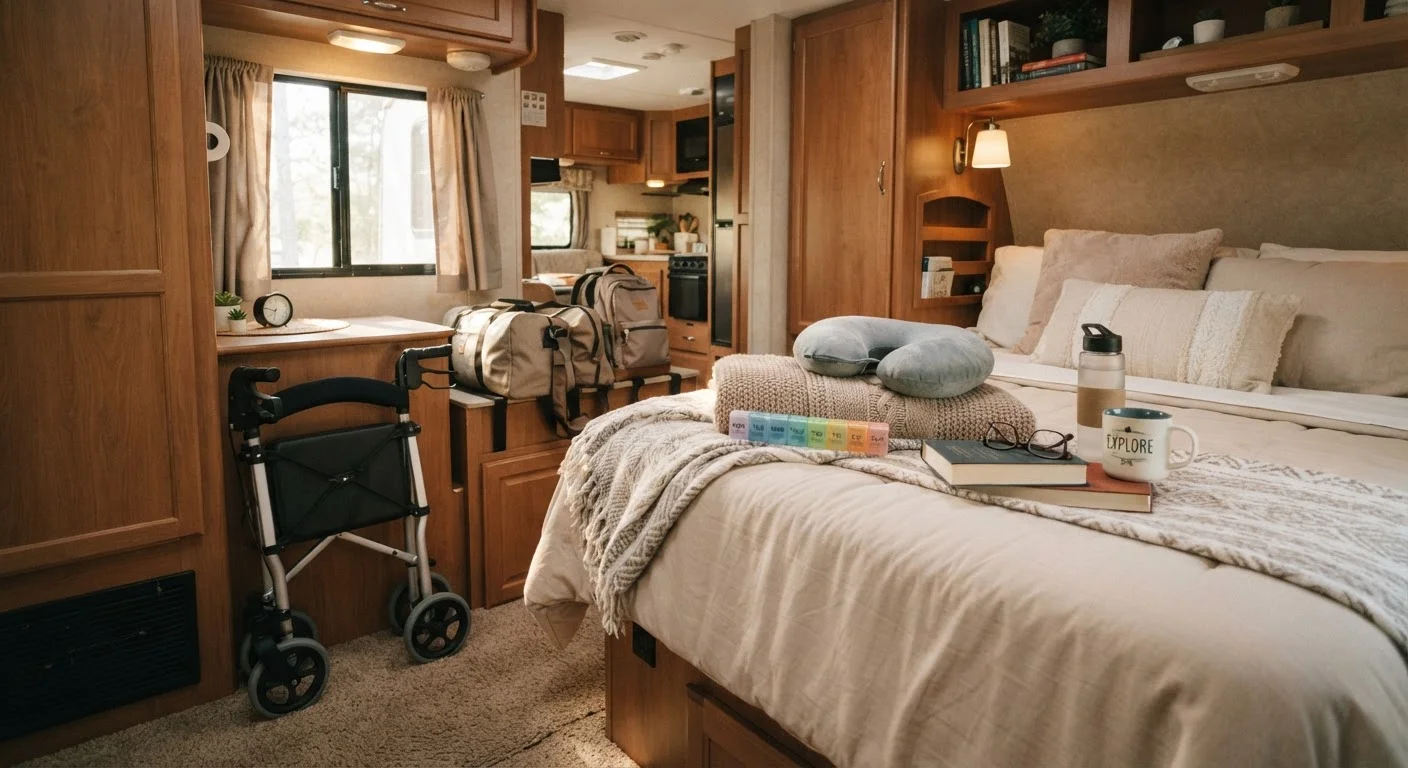
Key Takeaways
- Prioritize mobility aids and medical supplies before any other packing decisions.
- RV space is limited — every item should serve a clear comfort or safety purpose.
- Medication storage requires planning for temperature, organization, and easy access.
- Familiar comfort items meaningfully reduce fatigue and stress on longer trips.
- Leaving behind bulky, rarely-used items preserves space and makes daily life easier.
- A well-packed RV reduces physical strain and supports independence on the road.
Why Packing Differently for RV Travel Matters
Packing for an RV trip is a fundamentally different exercise than packing for a hotel stay or a cruise. You're bringing your home with you — but that home has strict limits on weight, storage space, and accessibility. For senior travelers, those constraints intersect with real daily needs: medications that must stay temperature-controlled, mobility aids that can't be left behind, and comfort items that make the difference between a restorative trip and an exhausting one.
The good news is that thoughtful packing isn't about packing less — it's about packing purposefully. Each item you bring should earn its place. This guide walks through the categories that matter most for older RVers, from what to prioritize to what you can safely leave at home.
For a broader look at pre-trip preparation, the Senior RV Trip Planning Checklist covers health documentation, vehicle prep, and route planning in detail. This article focuses specifically on what goes in the bags.
Mobility Aids: Non-Negotiable Packing Priorities
Whatever mobility aids you use at home — a cane, walker, rollator, or portable grab bars — they travel with you, full stop. RV environments present uneven terrain, narrow aisles, and entry steps that can challenge balance even for steady walkers.
A few practical considerations:
- Portable grab bars (suction-cup or clamp-on types) can be attached to RV bathroom walls where permanent fixtures don't exist — though always test adhesion before relying on them.
- A small folding step stool with a handle helps with entry and exit if your RV has a high first step.
- If you use a wheelchair or power scooter, confirm in advance that your campsite has a paved or firm-surface pad and that your RV's storage bay or rear carrier can accommodate it safely.
For guidance on permanent RV modifications that complement your mobility aids, see RV modifications for aging in comfort.
Mobility aids used at home must travel with you — RV terrain demands them more, not less.
Medication Storage: Temperature, Organization, and Access
Medications are among the most critical items to plan for, and RV travel introduces specific challenges: temperature fluctuations inside a parked rig, limited refrigeration space, and the risk of items shifting in transit.
- Temperature-sensitive medications should be stored in a small dedicated cooler or the RV refrigerator — never left in a hot vehicle cab or storage bay.
- A weekly pill organizer with clear AM/PM compartments reduces confusion and makes it easy to confirm you haven't missed a dose.
- Keep a 30-day supply minimum if possible, and carry a printed or digital list of all medications with dosages — useful if you need to visit a pharmacy or urgent care while traveling.
- Store medications at accessible height — not in overhead bins that require reaching or climbing.
For a detailed look at managing prescriptions and healthcare routines on the road, managing medications while RVing provides practical general guidance. Always consult your own healthcare provider before travel regarding your specific medication needs.
A printed medication list with dosages is essential if you need urgent care away from home.
Sleep and Comfort: The Items That Restore You
Sleep quality often declines in unfamiliar environments, and an uncomfortable night compounds fatigue over a multi-day trip. Bringing a few targeted comfort items can make a meaningful difference.
- Your own pillow is one of the most impactful items you can pack — familiar support for neck and head alignment matters.
- A mattress topper (memory foam toppers compress well for storage) can significantly improve an RV mattress that may be thinner or firmer than your bed at home.
- Ear plugs or a white noise app help manage campground noise — generators, early risers, and wildlife are common.
- A nightlight or motion-activated light strip in the sleeping area and bathroom reduces fall risk during nighttime movement.
For more on optimizing your sleeping setup, setting up an RV bedroom for better sleep offers practical configuration tips.
Bringing your own pillow and a motion-activated nightlight are small upgrades with outsized comfort payoffs.
Clothing and Footwear: Practical Over Packed
Overpacking clothing is one of the most common RV packing mistakes. Closet and drawer space is genuinely limited, and hauling excessive luggage in and out of storage bays adds unnecessary physical strain.
- Pack for layers, not variety. Temperature shifts — especially in elevated destinations like mountain campgrounds — matter more than outfit choices. A few versatile pieces in neutral colors that mix and match serve you better than a large wardrobe.
- Footwear is critical. Bring one pair of sturdy, slip-resistant walking shoes for uneven terrain, one comfortable casual pair, and sandals if the climate calls for them. Avoid packing dress shoes that won't be used.
- Compression socks are worth including if you have circulation concerns — especially for long driving days. Consult your doctor about whether they're appropriate for your situation.
If you're traveling to high-altitude destinations, RV camping in the Rocky Mountains covers temperature and comfort preparation specific to mountain environments.
Footwear matters more than wardrobe variety — one sturdy, slip-resistant pair is worth more than three dress options.
What to Leave Behind: Reclaiming Space Strategically
Knowing what not to pack is just as valuable as knowing what to bring. Common space-wasters in senior RV packing include:
- Duplicate kitchen tools — RVs come equipped with basic cookware. Bringing a full set from home is redundant and heavy.
- Hardcover books and printed maps — digital alternatives (e-readers, GPS apps) save significant weight and space.
- Formal clothing — unless your itinerary specifically includes events requiring it, formal wear consumes space without earning it.
- Exercise equipment — resistance bands and lightweight yoga mats are the exception; bulky equipment rarely gets used and is difficult to store.
- Excessive cleaning supplies — a small, multi-purpose kit covers most needs. Full-size bottles are inefficient.
For those also planning non-RV legs of their journey, packing light without leaving essentials behind offers strategies applicable across travel types.
Every item left behind creates space for what you actually need — and reduces physical strain loading and unloading.
Health and Safety Supplies: The Items Worth the Space
Beyond medications, a compact health and safety kit belongs in every senior RV. Think of it as a first-response layer before professional care is available — not a replacement for medical attention.
- First aid basics: bandages, antiseptic wipes, medical tape, and a digital thermometer.
- Emergency contact card: printed and laminated, listing your doctor, emergency contacts, insurance information, and any critical medical history. Keep one in the RV and one in your wallet.
- A portable blood pressure cuff if you monitor your blood pressure regularly — these pack flat and provide peace of mind on longer trips.
- Sunscreen, insect repellent, and a hat — outdoor exposure at campgrounds is often greater than at home.
The Senior RV Readiness Checklist also addresses health documentation and emergency preparation as part of a complete pre-departure review.
A laminated emergency contact card with medical history belongs in your wallet and the RV — always.
Final Thoughts: Pack With Purpose
Good packing is a form of self-care. When your RV is organized around your actual needs — rather than a generic checklist — daily life on the road becomes noticeably smoother. You spend less time searching, less energy lifting, and more time enjoying the journey.
Try a Shakedown Trip First
Before a long journey, do a one- or two-night test run close to home. This reveals what you actually reach for, what you never opened, and whether your mobility aids and comfort items are positioned for easy daily use. Adjusting your packing list after a short trial run saves real frustration on a major trip.
If this is your first extended RV trip, consider doing a short shakedown run of one or two nights before your main journey. You'll quickly discover what you're missing, what you brought unnecessarily, and how your space actually functions day-to-day. For deeper guidance on adapting your rig itself, see RV comfort modifications for older adults.
The Senior RV Living hub offers ongoing tips to help you travel comfortably and confidently at every stage of the journey.