

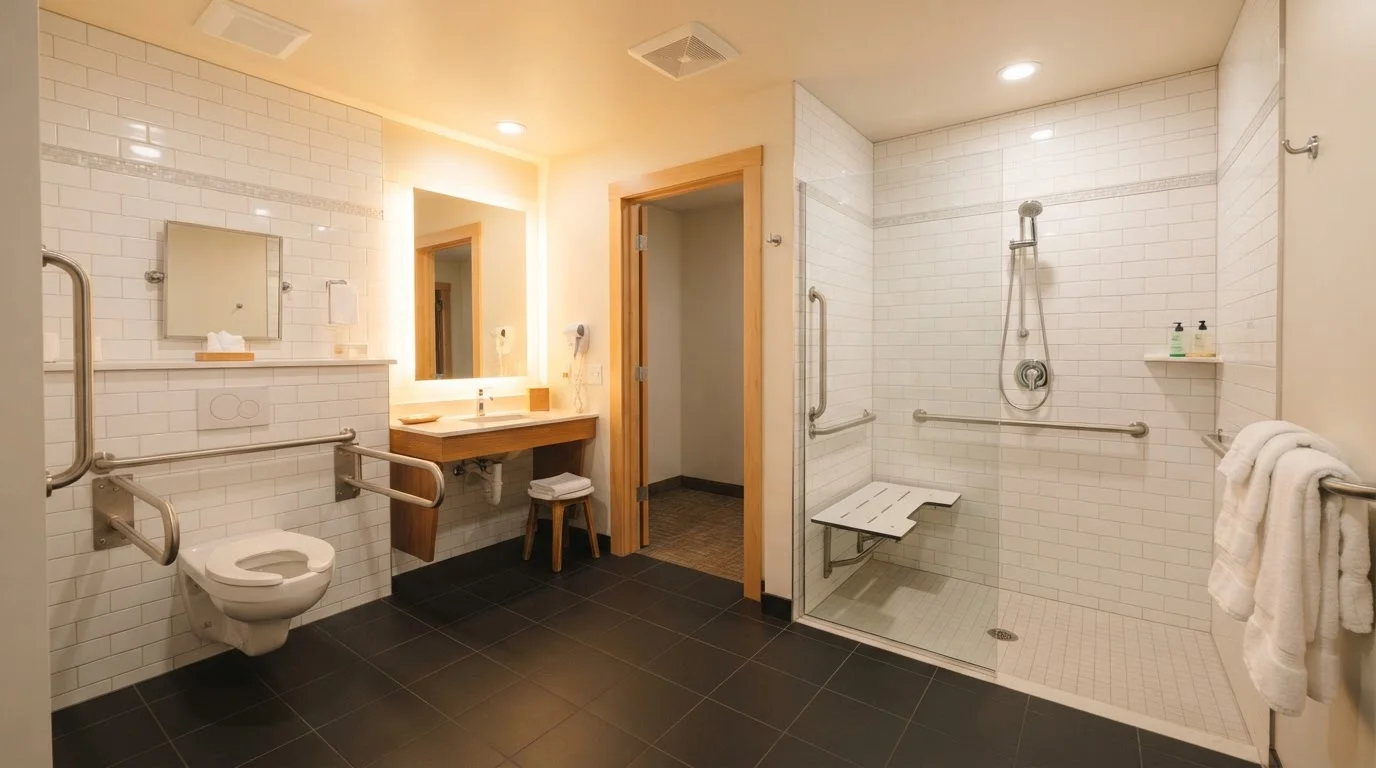
Key Takeaways
- ADA compliance is a legal minimum, not a comfort guarantee for senior travelers.
- Standards cover measurable features like doorway width and grab bar height — not mattress firmness or lighting quality.
- Older hotels may comply with earlier, less stringent ADA standards than newer properties.
- Accessible rooms can vary significantly between properties even when both are technically compliant.
- Calling the hotel directly is often the most reliable way to confirm specific accessibility features.
- Personal mobility needs should guide your questions — one standard does not fit all seniors.
ADA Compliant Hotel Room
An ADA compliant hotel room meets the minimum accessibility standards set by the Americans with Disabilities Act, a federal law enacted in 1990. These standards specify measurable requirements for things like doorway width, bathroom grab bar placement, and bed height clearance. Hotels with 15 or more rooms are legally required to provide a certain number of accessible rooms. Meeting these standards means a property has passed a legal threshold — not necessarily that it is optimally comfortable for every senior traveler.
ADA Standards for Accessible Design (2010 ADA Standards) govern new construction and alterations. Older hotels may comply under earlier standards, which can result in meaningful differences in the features you encounter on arrival.
What the ADA Actually Requires of Hotels
The Americans with Disabilities Act sets enforceable, measurable standards — not general guidelines. For hotel guestrooms, these standards include minimum doorway widths (typically 32 inches clear when the door is open), turning radius space within bathrooms, grab bar placement beside toilets and in showers, lowered peepholes, and accessible hardware like lever-style handles. Bed height clearance and closet rod accessibility are also addressed.
What the ADA does not regulate includes mattress firmness, shower water pressure, lighting brightness, or the softness of flooring. It also does not govern how far an accessible room is from the elevator, or whether the ice machine hallway has a tight corner. These comfort and convenience details — which matter enormously to many senior travelers — fall outside the law's scope.
For broader context on how physical environments affect senior travelers, the Mobility & Accessibility hub offers practical guidance organized around real-world travel scenarios.
ADA Covers New Construction and Alterations
Hotels built before the ADA took effect in 1990, or those that have not undergone significant alterations since, may have 'grandfathered' features that do not fully meet current standards. The law requires readily achievable barrier removal in existing facilities, but what qualifies depends on factors like cost and structural feasibility. This means ADA compliance can look different from property to property even when all are operating legally.
Why Two 'Compliant' Rooms Can Feel Very Different
ADA compliance is a threshold, not a score. A hotel built in 1995 and renovated in 2005 may comply with the standards in effect at the time of its last significant alteration — which are less stringent than the 2010 ADA Standards that apply to new construction today. Both properties can truthfully call their rooms ADA compliant, yet the actual features may differ considerably.
Consider grab bars: the 2010 standards specify both the required diameter and exact positioning relative to toilet centerlines and shower controls. An older installation may have bars in slightly different positions that still passed the rules at the time. For a traveler with limited reach or balance concerns, that difference can be significant.
This is why the label alone is rarely enough. The article Why 'Accessible Room' Doesn't Always Mean What You Think explores how accessibility labels vary and what to look for in room descriptions before you commit to a booking.
32 in.
Minimum clear doorway width under ADA Standards
The 2010 ADA Standards for Accessible Design specify 32 inches of clear width when a door is open 90 degrees — a baseline that applies to guestroom entry and bathroom doors.
1 in 25
Accessible rooms required per total hotel rooms
For hotels with 101–150 rooms, the ADA requires at least 5 accessible rooms — a ratio that illustrates the minimum legal floor, not an indicator of overall accessibility quality.
2010
Year current ADA hotel standards took effect
The 2010 ADA Standards for Accessible Design apply to new construction and alterations after that date; older hotels may operate under earlier, less detailed requirements.
How to Go Beyond the Label When Booking
The single most effective step a senior traveler can take is to call the hotel's front desk directly — not a central booking line — and ask specific questions. Request the dimensions of the roll-in shower opening. Ask whether the accessible bathroom has a fold-down bench. Confirm whether the accessible room is near an elevator. These are concrete, answerable questions that reveal far more than a checkbox on a booking site.
When reading listings online, look for properties that describe their accessible features in detail rather than simply stating 'ADA compliant.' Specific language — 'roll-in shower with bench,' '36-inch doorway,' 'lowered bed frame available' — signals that staff are trained to communicate accessibility clearly.
Accessibility Features That Actually Matter in a Hotel Room breaks down which physical features tend to make the greatest practical difference, so you can prioritize your questions accordingly. And when you're ready to evaluate a specific property in detail, the room-by-room accessibility checklist provides a structured framework to use before confirming any reservation.
Call the Property Directly Before Booking
Central reservation lines and online booking platforms often lack detailed accessibility information. Call the hotel's front desk and ask specific questions: Is the accessible bathroom a roll-in shower or a tub with grab bars? How far is the accessible room from the elevator? Is a shower bench available? Getting clear answers in writing — via email confirmation — also gives you documentation if the room does not match expectations on arrival.
Using Reviews and Peer Feedback to Fill the Gaps
Guest reviews frequently surface real-world accessibility details that official listings omit. Travelers who use mobility aids, walkers, or have limited stamina often leave candid observations about elevator reliability, bathroom layout practicality, and the distance from parking to the lobby. These firsthand accounts can be more informative than any official compliance statement.
The challenge is filtering reviews to find the ones relevant to your needs. Searching review text for terms like 'grab bar,' 'wheelchair,' 'walker,' or 'shower bench' can surface the most useful entries quickly on most major booking platforms. Look for patterns across multiple reviews rather than relying on a single account.
For a fuller guide on reading hotel reviews through a senior traveler's lens, see Reading Hotel Reviews as a Senior Traveler: What to Look For. Accessibility at the room level is also only one part of the picture — evaluating the destination itself for terrain, infrastructure, and healthcare proximity rounds out a thorough pre-trip assessment.
This article provides general informational guidance about hotel accessibility standards and is not legal advice. ADA requirements are subject to change; consult the U.S. Department of Justice or a qualified professional for authoritative guidance on your specific situation.