

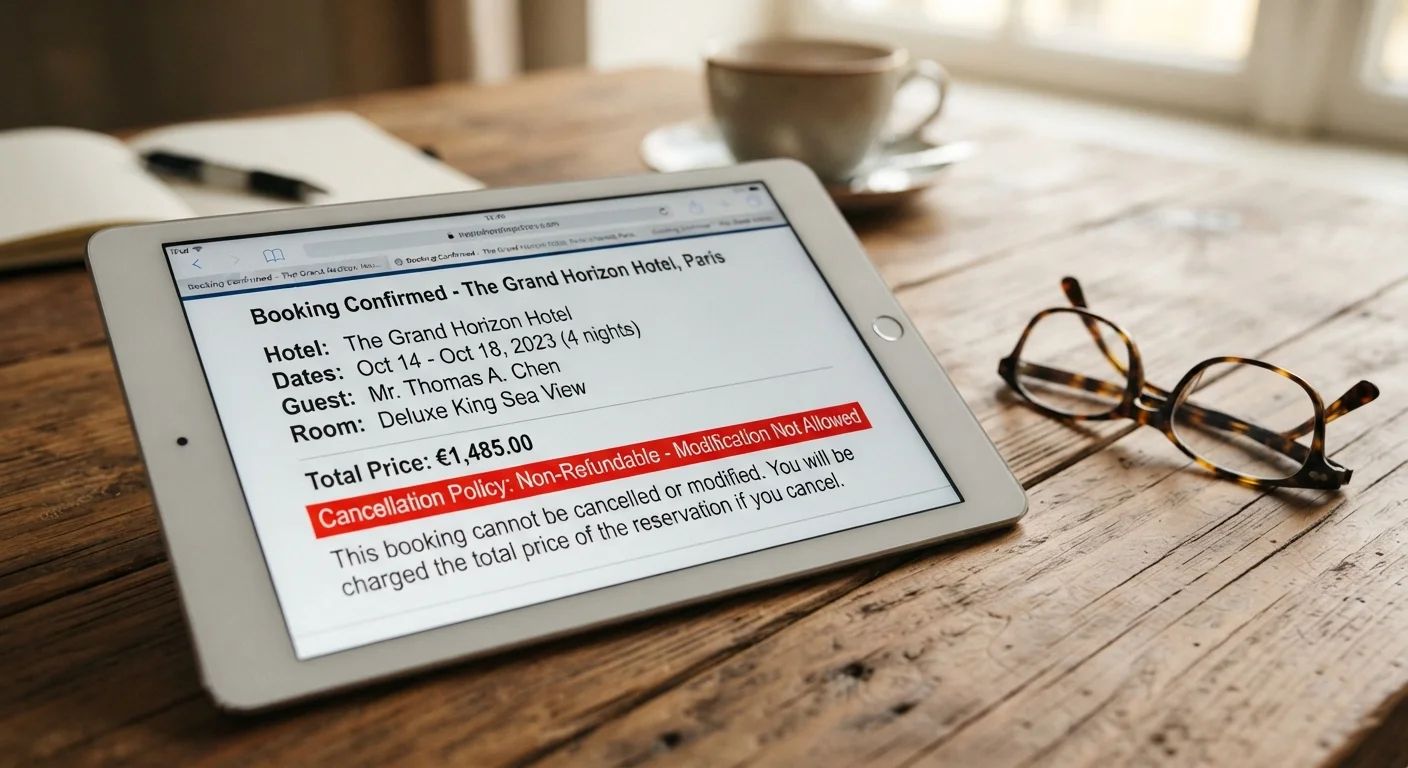
Key Takeaways
- Non-refundable means you lose your payment if you cancel — for almost any reason.
- The price difference between refundable and non-refundable rates is often smaller than it appears.
- Travel insurance may cover certain cancellation costs, but policy terms and exclusions vary widely.
- Non-refundable bookings carry higher risk for travelers with health concerns or uncertain plans.
- Always read the cancellation policy before confirming — not after.
Non-Refundable Booking
A non-refundable booking is a reservation — for a hotel room, flight, cruise cabin, or tour — where you pay upfront and forfeit that payment if you cancel, regardless of the reason. Unlike a flexible or refundable rate, you generally cannot get your money back once the booking is confirmed. Some providers may allow changes for a fee, but full refunds are typically off the table.
The exact terms vary by provider and booking platform. Some non-refundable rates permit date changes for a penalty fee; others are entirely fixed. Always read the specific cancellation policy attached to your reservation, not just the rate label.
What You're Actually Agreeing To
When you see a rate labeled non-refundable, it means the provider keeps your money if you cancel — full stop. There is no grace period in most cases, no partial credit, and no goodwill exception for unexpected events. Once you click confirm, that payment is committed.
This applies across nearly all travel categories: hotel rooms, airline tickets, cruise fares, vacation rental deposits, and packaged tours. The label can appear slightly differently — "advance purchase," "saver rate," or "restricted fare" — but the underlying rule is the same: cancel, and you forfeit what you paid.
What catches many travelers off guard is the assumption that a good enough reason will unlock a refund. Providers are not typically obligated to make exceptions, even for illness, family emergencies, or flight disruptions on your end. Before you confirm, treat the payment as spent — and ask yourself whether you're comfortable with that.
See our pre-booking review checklist to help you catch these details before you finalize any reservation.
The Hidden Cost of Saving a Little
Non-refundable rates often look attractive because they're priced lower than flexible alternatives. But the savings can be deceptive when you look closely at the numbers.
~10–20%
Typical price gap between non-refundable and flexible rates
Industry travel pricing analyses generally show non-refundable hotel and flight rates average 10–20% below fully flexible equivalents, though this varies significantly by provider and destination.
100%
Amount forfeited on a strict non-refundable cancellation
Under standard non-refundable terms, travelers who cancel receive no monetary refund — the full booking cost is retained by the provider.
If a refundable hotel room costs $180 per night and the non-refundable version costs $155, you're saving $25. But if something changes and you can't travel, you lose $155 rather than nothing. That $25 discount becomes an expensive gamble.
The calculus shifts depending on how certain your plans are. A healthy traveler with fixed, firm travel dates and no foreseeable complications may find non-refundable rates a reasonable choice. For seniors managing ongoing health conditions, caring for a spouse, or traveling with others whose plans might change, the flexibility of a refundable rate often carries real practical value — even at a higher price.
Common booking assumptions that don't always hold up — including beliefs about non-refundable rates — are worth understanding before you commit.
When to Avoid a Non-Refundable Rate
There are situations where non-refundable bookings carry meaningful risk that outweighs any savings. Consider choosing a refundable or flexible option if any of the following apply to you:
- Your health situation is variable. If a medical appointment, treatment schedule, or chronic condition could realistically affect your travel, a flexible rate provides an important safety net. This is general guidance — speak with your healthcare provider about any health-related travel decisions.
- You're booking far in advance. The further out you book, the more time there is for circumstances to change. Long lead times increase the practical value of flexibility.
- Other travelers in your group have uncertain plans. If a family member or travel companion might not be able to go, a non-refundable booking for the full group creates unnecessary financial risk.
- You haven't confirmed all the moving pieces. If flights, transportation, or other arrangements aren't yet confirmed, locking in a non-refundable hotel can leave you exposed.
Ask About Modification Options Before You Book
Even if a rate is non-refundable, some providers allow you to change travel dates for a fee rather than canceling outright. Before confirming, call or chat with the provider and ask specifically: 'If I need to change my dates, what are my options?' Get the answer in writing if possible. Knowing your options in advance is far less stressful than finding out after plans change.
Cruise travelers face a particularly complex version of this. Final payments and cancellation penalties on cruise bookings often operate on a sliding scale — the closer to departure, the less you recover. For more on avoiding costly cruise booking mistakes, see our guide to cruise booking regrets seniors often face.
Travel Insurance and Non-Refundable Bookings
Travel insurance is sometimes positioned as a solution to the non-refundable booking problem — and it can help, but it's not a guaranteed safety net. Coverage depends entirely on the specific policy you purchase, the reason you're canceling, and whether that reason is a covered event under your plan.
Common covered reasons include serious illness or injury, the death of a family member, jury duty, or certain natural disasters. Common exclusions include pre-existing conditions (unless a waiver is purchased), change of mind, fear of travel, and situations that don't meet the policy's specific definitions.
This content is general information only and does not constitute insurance or financial advice. Coverage terms, exclusions, and eligibility vary by provider and policy. Read your policy documents carefully and consult a licensed insurance professional before making decisions.
Understanding why claims get denied is just as important as knowing what's covered. Our article on why travel insurance claims are often denied walks through the clauses travelers most commonly overlook.
After booking, take time to review your confirmation carefully. Our guide on reading a booking confirmation email thoroughly explains exactly what to look for — and what to do if something doesn't look right.