

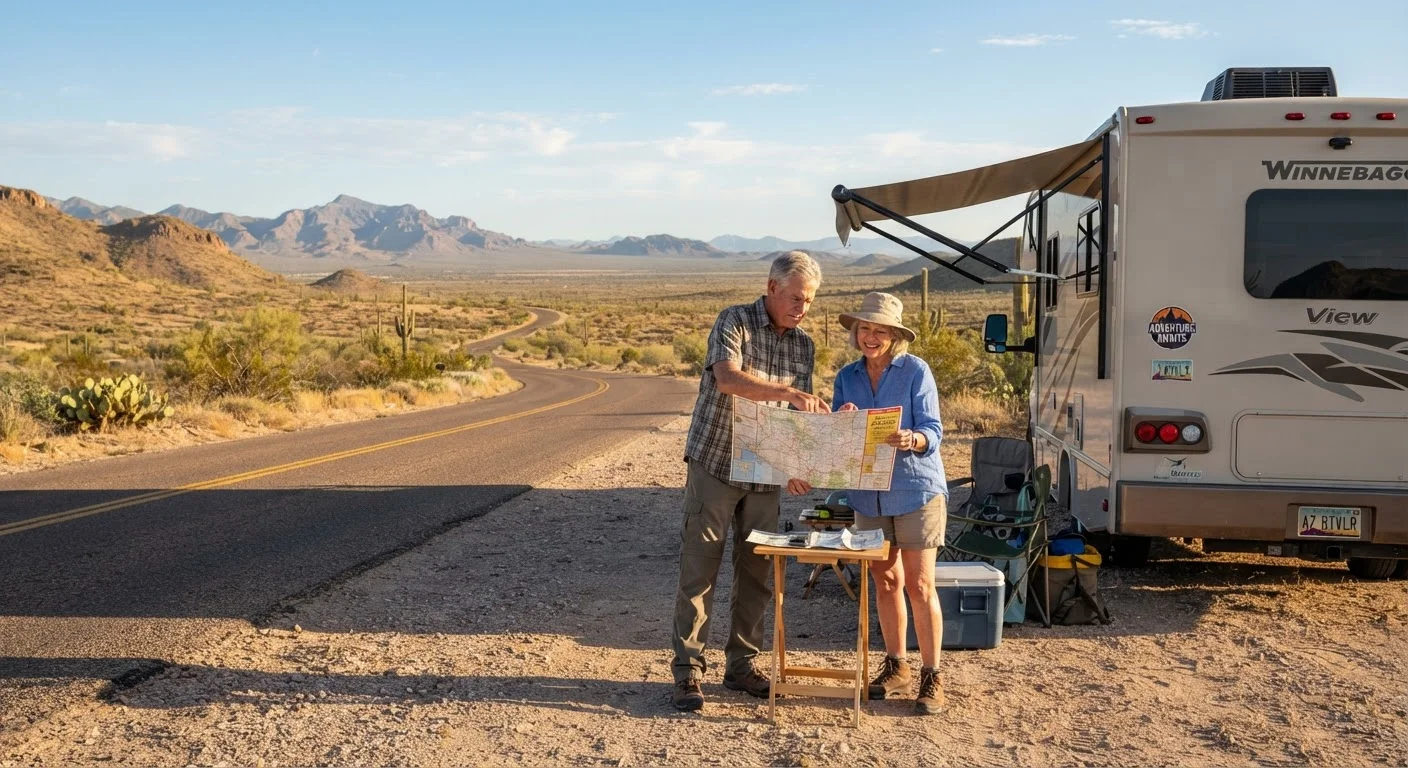
Key Takeaways
- Satellite communicators provide emergency contact capability where cell signals don't reach.
- Downloaded offline maps are an essential backup when internet connectivity fails on remote routes.
- Sharing a detailed trip itinerary with a trusted contact is one of the simplest and most effective safety habits.
- Checking cellular coverage maps before departure helps you anticipate and plan around dead zones.
- Combining multiple communication tools — not relying on one — builds the most reliable safety net.
Why Remote Routes Demand Extra Preparation
Exploring less-traveled roads is one of the most rewarding parts of RV travel — but heading into areas with limited infrastructure requires deliberate planning, especially for senior travelers. Cell coverage gaps, unpaved roads, and long distances between services can turn a minor inconvenience into a serious situation if you're not prepared.
This isn't a reason to avoid remote routes. It's a reason to approach them with the right tools and habits in place. As part of a broader strategy — see our complete guide to senior RV planning — communication and navigation readiness are among the highest-priority items to address before departure.
Coverage Maps Have Limits
Carrier coverage maps provide a useful starting point, but they often reflect best-case signal conditions. Terrain features like mountains, deep valleys, and dense forest can significantly reduce actual coverage compared to what a map predicts. When in doubt, plan for no signal in any area that appears marginal on a coverage map.
Mapping Your Coverage Before You Go
Before selecting a remote route, spend time reviewing cellular coverage maps from your carrier. Most major carriers publish interactive coverage maps online. Cross-reference your planned corridor against these maps and identify segments where signal is likely to be weak or absent. Mark those gaps on your itinerary.
Keep in mind that coverage maps reflect general service areas and may not capture real-world conditions in canyons, dense forest, or mountainous terrain. Treat any area marked as marginal as a likely dead zone and plan accordingly. RV travel forums and campground review sites can also offer firsthand accounts of connectivity at specific stops along popular remote routes.
~70%
US land area with limited or no cell coverage
According to Federal Communications Commission data, a significant portion of US land area — particularly rural and wilderness regions — falls outside reliable cellular coverage, highlighting the need for backup communication tools.
1 in 3
Older adults who travel without an emergency contact plan
Travel safety research consistently finds that a substantial share of older solo travelers depart without a formal check-in agreement, leaving a critical gap in their safety net.
Emergency Communication Devices for Off-Grid Travel
When cellular networks aren't available, satellite-based communication devices fill the gap. These tools use satellite networks rather than cell towers, which means they function in extremely remote areas where no phone signal exists.
Carry a dedicated satellite communicator on every remote route.
Satellite communicators send SOS signals and two-way messages via satellite networks, independent of any cell infrastructure. In a medical emergency or vehicle breakdown in a dead zone, this device may be the only way to summon help. Many units also allow regular non-emergency check-in messages.
Register your device and test it before your trip departs.
An unregistered or untested satellite communicator may not function as expected in an emergency. Registration links the device to your emergency contacts and ensures rescue coordination centers can reach the right people. Testing confirms the device is active and your subscription is current.
Download offline maps for your entire planned route before leaving a strong connection area.
Navigation apps that rely on live data will fail without internet. Pre-downloaded maps work entirely on the device without any connection, ensuring you can follow your route, reroute around obstacles, and locate nearby services even in areas with no signal.
Write down key waypoints, campground addresses, and emergency numbers on paper.
Electronic devices can run out of battery, fail, or become inaccessible in an accident. A written record of your route, stops, and key contacts is a simple, fail-safe backup that requires no power and never loses signal.
For solo travelers especially, a dedicated emergency communicator is close to essential. Our guide to solo senior RV travel preparations covers how to build a broader communication plan around tools like these.
Navigating Without an Internet Connection
GPS and mapping apps that rely on a live data connection will fail in dead zones. The solution is simple but often overlooked: download your route maps for offline use before you leave a connected area.
Most dedicated GPS navigation apps allow you to save regional maps directly to your device's storage. Supplement digital tools with a current paper road atlas — particularly useful in areas where roads may not be fully represented in digital databases. Always carry written directions for your key waypoints rather than depending entirely on turn-by-turn voice guidance.
Building a Check-In Routine With Someone You Trust
One of the most underused safety practices is also one of the most effective: leaving a detailed trip plan with a trusted contact and establishing a regular check-in schedule. Before departing, share your planned route, campsite stops, expected arrival dates, and the name of any campground hosts you anticipate meeting.
Agree on a check-in frequency — daily or every other day is typical — and specify what your contact should do if they don't hear from you by an agreed time. This creates a human safety net that technology alone cannot replicate. For guidance on maintaining regular family communication during extended trips, see staying connected with family while RVing.
Set a Specific Check-In Window
Rather than saying 'I'll check in each day,' agree on a specific time window — for example, between 7 and 9 p.m. — and a defined action your contact should take if they don't hear from you by a set hour. This removes ambiguity and ensures your safety net activates at the right moment, not just when someone happens to notice silence.
Packing for the Gaps: Practical Supplies for Dead Zones
Beyond communication devices and navigation tools, a few physical supplies make remote travel significantly safer. A portable power bank keeps devices charged when shore power isn't available. A basic first aid kit, a printed list of emergency contacts and medical information, and a vehicle emergency kit — including reflective triangles and a basic toolkit — round out a sensible remote-travel setup.
For a structured pre-departure review, the senior RV readiness checklist walks through vehicle safety, health documentation, and emergency contact preparation in one place. Additional wellness considerations for travel are covered in our travel health tips and travel safety tips resources.