

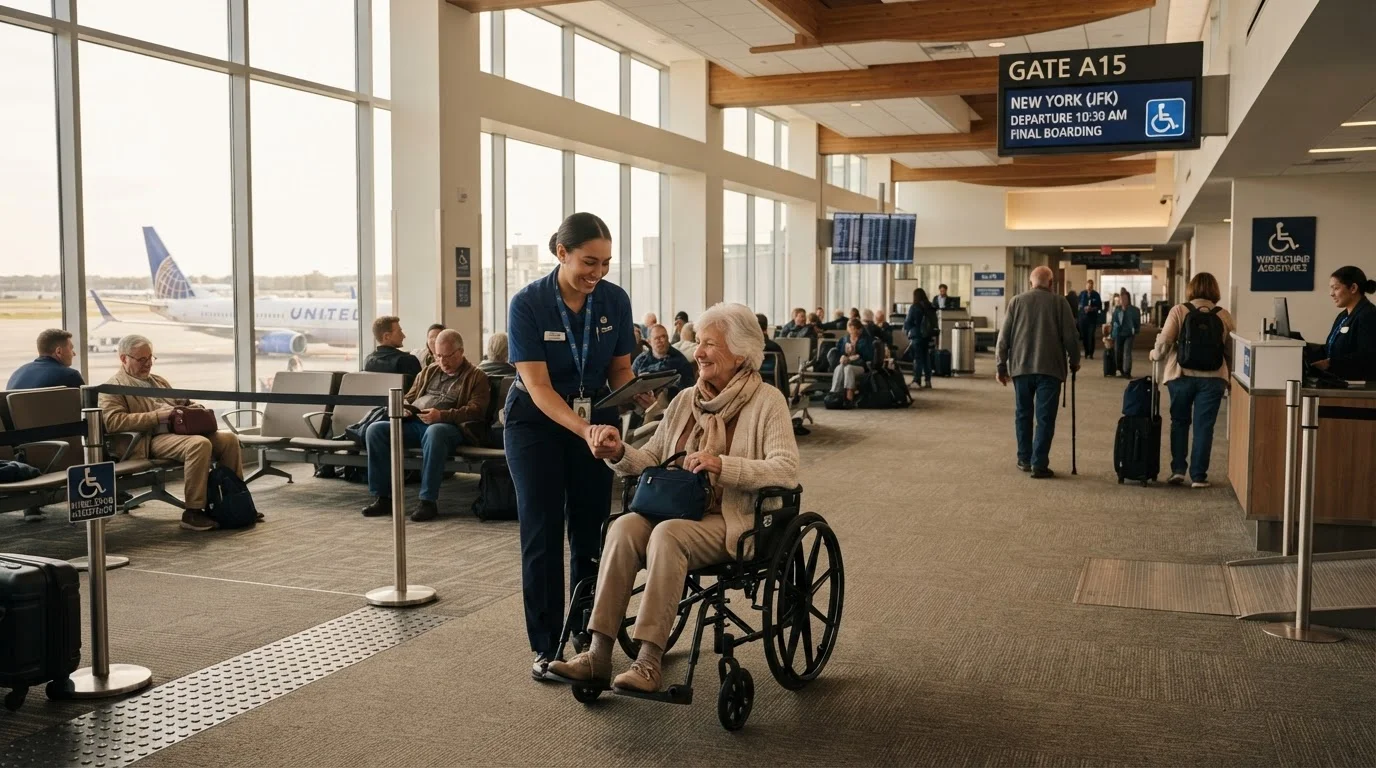
Key Takeaways
- Airport special assistance is free and legally required under the Air Carrier Access Act.
- It covers wheelchair service, escort through security, and priority boarding.
- You do not need a formal disability diagnosis to request assistance.
- Requesting in advance — at booking — leads to the most reliable service.
- Airlines and airports coordinate separately; notify both when possible.
Airport Special Assistance
Airport special assistance refers to a set of free, coordinated services airlines and airports are required to provide to passengers with disabilities or mobility challenges. These services cover everything from wheelchair transport and dedicated check-in help to priority boarding and guided escort through security. Any passenger who needs it — including seniors managing fatigue, joint pain, or temporary injury — can request it.
In the United States, these services are governed by the Air Carrier Access Act (ACAA), which requires airlines to offer assistance to passengers with physical or cognitive disabilities at no additional charge.
What the Service Actually Includes
Many travelers assume special assistance is limited to wheelchair use, but the service spans the entire airport journey. Here is what it typically covers:
- Wheelchair transport: From the terminal entrance (or curbside drop-off) to the gate, and from the arrival gate to baggage claim or ground transport on landing.
- Escort through security: A staff member accompanies you through TSA checkpoints and helps manage your carry-on items during screening.
- Priority boarding: Passengers using special assistance board before general boarding groups, giving more time and space to settle in.
- Aisle chair service: A narrow, specialized wheelchair used to transport passengers down the aircraft aisle to their seat.
- Assistance with connections: If your itinerary includes a connecting flight, airport staff coordinate your transfer between gates.
Note that assistance ends at your aircraft seat. Airlines are not required to assist with tasks like cutting food or retrieving items from overhead bins during the flight, though many flight attendants will help informally.
Airports and Airlines Are Separate Entities
Wheelchair and escort services at U.S. airports are typically coordinated by the airline, not the airport authority. This means you need to notify your airline — not just the airport — when requesting assistance. If you are flying on multiple carriers in one trip, notify each airline separately for each leg of the journey.
Who Is Eligible — and Common Misconceptions
A common misconception is that special assistance is reserved for passengers with severe or permanent disabilities. In practice, eligibility is broad. Under the Air Carrier Access Act, assistance is available to any traveler who has a physical or mental impairment that affects a major life activity — which includes walking long distances, standing for extended periods, or navigating complex terminal environments.
This means seniors managing arthritis, recent hip replacements, heart conditions affecting stamina, or simply the fatigue of navigating a large hub airport are all eligible. You do not need to disclose a specific diagnosis. Stating that you need help walking long distances or would benefit from a wheelchair is sufficient.
For a broader look at what accessibility in travel really means, see Accessible Travel: What the Term Actually Covers — it explains the full range of features worth considering before you book.
You Don't Need to Explain Your Diagnosis
When requesting special assistance, you are not required to name a specific medical condition. Simply describe what you need — for example, 'I have difficulty walking long distances' or 'I need help navigating stairs.' Airlines are prohibited from demanding detailed medical justification for most standard accessibility services.
How to Request It — and When
The most reliable way to ensure assistance is to request it at the time of booking. Most airline websites include an accessibility or special assistance section during checkout. If you book by phone, tell the agent directly. Once booked, confirm the request when you check in online and again when you arrive at the airport.
Arriving early matters. Airport staff who provide wheelchair service work from scheduled lists. Arriving at least 90 minutes before a domestic flight (and longer for international travel) gives the team time to respond. When you arrive at the terminal, go to the airline's check-in counter rather than a self-service kiosk, and identify yourself as a passenger with an assistance request.
For a detailed walkthrough of the full airport journey — from drop-off zone to the boarding gate — see Airport Accessibility from Kerb to Gate. And if you want step-by-step guidance on making the formal request, Requesting Special Assistance at Airports and Train Stations covers exactly how to communicate your needs clearly.
~3.6M
Wheelchair assistance requests annually at U.S. airports
According to data cited by the U.S. Government Accountability Office in its reporting on airport accessibility services.
48 hrs
Advance notice recommended by most U.S. airlines
Most major U.S. carriers ask passengers to request special assistance at least 48 hours before departure to ensure proper staffing and equipment.
What to Do If Something Goes Wrong
Despite legal protections, service gaps do occur. Wheelchairs are sometimes delayed, staff are not always at the gate, and connecting flight handoffs can break down. Knowing your options reduces stress when things don't go as planned.
- At the airport: Speak immediately with an airline customer service agent or the airport's accessibility desk. Most airports have a dedicated accessibility coordinator on duty.
- After the flight: File a written complaint with the airline. Under DOT rules, airlines must acknowledge disability-related complaints within 30 days and resolve them within 60 days.
- With the government: The U.S. Department of Transportation's Aviation Consumer Protection Division accepts complaints from passengers who feel their ACAA rights were not met.
Keeping a brief written record — noting times, names of staff involved, and what was or wasn't provided — strengthens any complaint you file. For more on managing accessibility needs across your whole trip, explore the Mobility & Accessibility hub for practical guidance on every stage of travel.