

| Hearing Loss Prevalence (65+) | Approximately 1 in 3 adults over 65 have disabling hearing loss (World Health Organization) |
| Best Time to Request Accommodations | At the time of booking — not within 30 days of sailing (General industry guidance from cruise accessibility desks) |
| Hearing Loop Coverage | Main theaters and auditoriums on many newer ships; varies by vessel |
| Large-Print Materials | Available on request from guest services or the accessibility coordinator |
| Visual Alert Devices | Strobe alarms, door-knock lights, and vibrating alarm clocks available on request |
| Service Animal Policy | Must be disclosed at booking; port entry rules vary by country |
Why Sensory Accessibility Matters on a Cruise
Mobility accommodations get most of the attention in cruise accessibility discussions — ramps, wider cabin doors, roll-in showers. But for the millions of older adults living with hearing loss or low vision, the gap between a comfortable voyage and a frustrating one often comes down to entirely different factors: whether they can follow an onboard announcement, read a daily program, or enjoy an evening show.
The good news is that cruise lines have meaningfully expanded sensory accessibility features in recent years. Understanding what to look for — and how to request it — puts you in a much stronger position before you ever step aboard. See our cruise accessibility checklist for the broader questions worth asking at the booking stage.
| Hearing Loss Prevalence (65+) | Approximately 1 in 3 adults over 65 have disabling hearing loss (World Health Organization) |
| Best Time to Request Accommodations | At the time of booking — not within 30 days of sailing (General industry guidance from cruise accessibility desks) |
| Hearing Loop Coverage | Main theaters and auditoriums on many newer ships; varies by vessel |
| Large-Print Materials | Available on request from guest services or the accessibility coordinator |
| Visual Alert Devices | Strobe alarms, door-knock lights, and vibrating alarm clocks available on request |
| Service Animal Policy | Must be disclosed at booking; port entry rules vary by country |
Hearing Accessibility: What Ships Commonly Offer
Ships certified to international maritime standards increasingly incorporate hearing-loop technology (also called an induction loop or telecoil system) in theaters, auditoriums, and sometimes at guest services desks. These systems transmit audio directly to hearing aids or cochlear implant processors equipped with a T-coil (telecoil), reducing background noise significantly.
Beyond loops, guests with hearing loss can often request:
- Amplified handset telephones in their stateroom
- Visual alerting devices — door knocker lights, alarm clock strobes, and flashing smoke detectors that replace or supplement audible signals
- Closed-captioned televisions in cabins, typically enabled through the TV menu
- Written transcripts or printed summaries of safety briefings (the mandatory muster drill), requested in advance through the accessibility desk
- Assistive listening devices (ALDs) — portable receivers available at the guest services or entertainment desk for use during shows and lectures
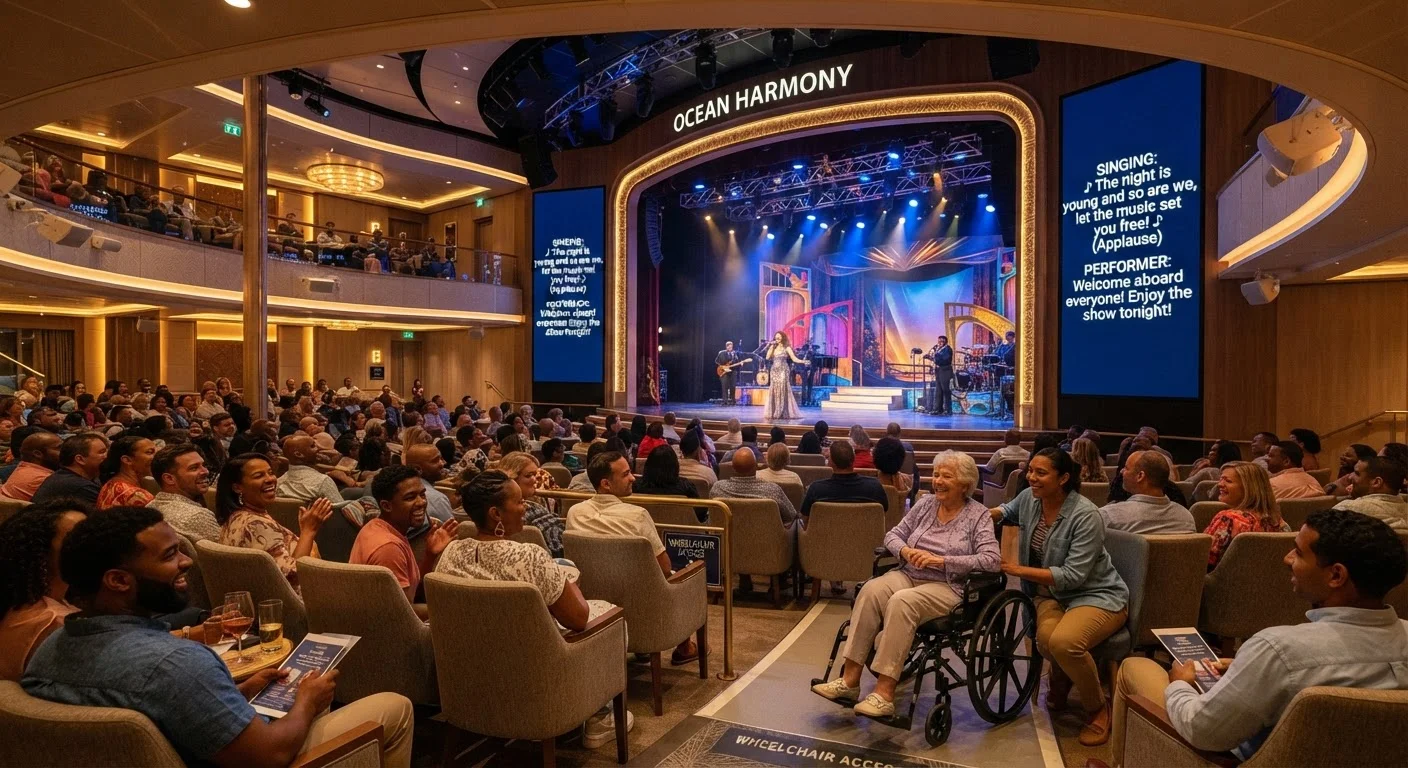
Captioned entertainment in main theaters varies by ship and itinerary. Open captioning (text displayed on a screen visible to all) is more common than individual captioning devices, though some newer vessels offer both. Always confirm availability for specific sailings before booking.
Hearing Loop / Induction Loop
A wire system installed around a room that generates a magnetic field, transmitting audio directly to hearing aids or cochlear implants equipped with a T-coil. It reduces ambient noise and significantly improves speech clarity for users.
T-Coil (Telecoil)
A small sensor built into many hearing aids and cochlear implant processors that picks up the magnetic signal from a hearing loop. Users typically activate it by switching to the "T" or "Loop" setting on their device.
Assistive Listening Device (ALD)
A portable receiver, often used with a neck loop or earbuds, that amplifies or wirelessly transmits sound from a microphone or audio source. Cruise ships may lend these for use in theaters and lecture halls.
Visual Alerting System
A suite of devices that use light flashes or vibration instead of sound to notify guests of events — including knocks at the door, telephone calls, alarm clocks, or fire alerts — in their stateroom.
Open Captioning
Text displayed on a visible screen during a live or recorded performance, readable by anyone in the audience. Unlike closed captions, it cannot be turned off by individual viewers.
Accessibility Services Coordinator
A cruise line staff member or department dedicated to managing disability accommodation requests. They serve as the primary point of contact for arranging assistive devices, special services, and disability-related needs before and during a voyage.
Vision Accessibility: Navigation, Information, and Entertainment
Low vision presents its own set of challenges at sea. Ship corridors can be long and visually similar, daily programs are often printed in small type, and menus in specialty restaurants may rely on dim mood lighting. Thoughtfully designed ships address several of these pain points.
Common accommodations for guests with low vision include:
- Large-print daily programs and menus — available on request, typically arranged through the accessibility coordinator before or at the start of the voyage
- Braille signage on elevator buttons and stateroom door numbers on many modern vessels
- Talking or high-contrast cabin safes and TV interfaces on select ships
- Orientation walkthroughs offered by crew members to help guests learn the ship's layout before it becomes crowded
- Screen reader-compatible apps on some cruise line mobile platforms, allowing guests to access daily schedules and dining menus on personal devices
Guests who use guide dogs or service animals should disclose this well ahead of sailing, as international port regulations governing animal entry vary considerably. This falls under the broader category of destination-level access planning covered in our guide on evaluating accessible destinations.
Service Animal Entry Rules Vary by Port
Even if your cruise line permits service animals onboard, individual ports of call — particularly international destinations — may have strict quarantine or documentation requirements that could restrict your animal from going ashore. Contact the embassies or official government agencies of each destination country before booking. Your cruise line's accessibility coordinator can also advise on historical precedents for specific itineraries, though official government sources remain the authoritative reference.
How to Secure These Accommodations Before You Sail
Most major cruise lines maintain a dedicated accessibility services desk — separate from general customer service — staffed by representatives trained specifically in disability accommodations. Contact this team at the time of booking, not closer to departure. Some assistive devices have limited onboard inventory and are assigned on a first-requested basis.
When you call or submit a written request, be specific: name the devices you use, describe your hearing or vision situation in functional terms (e.g., "I use hearing aids with T-coil" or "I have low vision and rely on large-print materials"), and ask for written confirmation of what will be provided. Our article on requesting special accommodations effectively offers practical language and documentation strategies that apply equally well to cruise bookings.
On embarkation day, verify your accommodations are in place before the ship departs. Guest services staff can often resolve gaps quickly while in port — far more difficult once at sea. The Mobility & Accessibility hub on this site gathers additional practical guidance for travelers navigating a range of sensory and physical needs.
~70%
Adults over 70 with measurable hearing loss
According to the National Institute on Deafness and Other Communication Disorders (NIDCD), about 70% of adults aged 70 and older have some degree of hearing loss.
2.2 million
Americans aged 65+ with significant vision impairment
The Centers for Disease Control and Prevention (CDC) reports that vision disability is one of the most prevalent disabling conditions among older U.S. adults.